On a Good Day: Lawrence Paul Yuxweluptun stands his ground

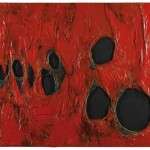
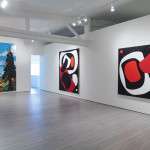
Yuxweluptun’s abstract paintings can seem off-kilter with his figurative works but, in fact, they share features. Dubbed “Ovoidism” by Yuxweluptun, the works employ the figure of the ovoid, although here, it is the sole graphic element. He also uses a more limited palette in the abstracts and, unlike the smooth surfaces of the landscapes, the paint is applied in a relatively thick impasto. The art historical references are often quite distinct, frequently reminding one of Paul-Émile Borduas and the Automatistes. Like their Surrealist forebears, the Automatistes were also striving to tap the creative stream of the subconscious.

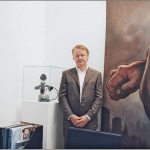
I tell myself only half-jokingly that Yuxweluptun subconsciously embraces them because, like him, they rejected the Catholic church. He characterizes his approach to the abstracts as purely intuitive, often without preliminary design. “I have fun making them,” he tells me. “There is an intellectual process of balance, design, colour, that comes out of just being. I like all the things about creating a neo-Native gaze. When you’re so busy being oppressed you have to take the time out to enjoy your own life. So it’s not always a bad colonial day. I’m having a good Indian day when I’m making. A good Indian day is a good day to be, to create.”
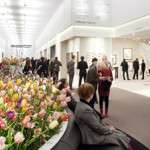

 

VIDEO: Judd Tully Tours TEFAF Maastricht 2014

MAASTRICHT, the Netherlands — TEFAF Maastricht (The European Fine Art Fair) is in full swing, and during its 12-day run the fair will show off works from 275 of the world’s premier art and antiques dealers.

Art+Auction Magazine editor-at-large and ARTINFO market reporter Judd Tully traveled to Maastricht to find out how much you can expect to pay for an Alexander Calder, and toured four of the fair’s booths focusing on works ranging from Old Masters to mid-20th century.

Watch the video.

Daily Pic: Art’s Favorite Subject

In art schools, there is an ancient rule – maybe first promulgated by Her Worship Marina Abramovic – decreeing that it’s not performance art until a girl takes her clothes off. This is a still from a brand-new six-minute video by Jennifer Bornstein, on view in the Whitney Biennial, that feels as though it’s revisiting that old conceit.

Guggenheim Museum Bilbao opens Yoko Ono restrospective

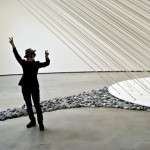
Yoko Ono (B. 1933, Tokyo) has been recognized as one of the most outstanding avant-garde artists for over sixty years. She is a pioneer in many of the artistic fields to which she has dedicated her life, and is considered to be one of the precursors to conceptual art, film and performance art. She is also a key figure in the music world, having produced numerous albums over the years. As you travel through the third floor of the Museum, you are led through the artist’s diverse spectrum of mediums used throughout her extensive career: from plastic arts to drawings, poetry, film, music, installations, video and performance art, among others. The heterogeneous shapes and mediums of her work challenge conventional ideas of art and raise questions that are essential to the human existence.

VIDEO: 60 Works in 60 Seconds from TEFAF Maastricht 2014

MAASTRICHT — Vincent van Gogh’s “Moulin de la Galette” from 1887 is one of four of the Dutch painter’s works — and one of many stunning discoveries — on view at TEFAF, The European Fine Art Fair, which opened Thursday in Maastricht, The Netherlands.

“Moulin de la Galette,” which was last exhibited in public in 1965, is up for sale by Dickinson of London and New York. The dealer is also featuring a pair of clogs by Paul Gauguin made in 1890.

Watch the Video, it will only take you 73 seconds …

Yoko Ono show at Guggenheim shines light on pioneering conceptual artist

Bilbao exhibition of installations, music and films demonstrates avant-gardiste’s true talents, her reach and influence.

‘The ladder John had to climb up was very high,” recalls Yoko Ono as we chat about one of her most famous works. It is called Ceiling Painting or Yes Painting, and it is one of the classics of conceptual art that fill her retrospective at the Guggenheim Museum in Bilbao. It consists of a stepladder leading up to a steel-framed panel and a dangling magnifying glass.  When John Lennon climbed up Ono’s ladder at the swinging London gallery Indica in 1966, there were more steps, but the word written above his head was the same as in this version: a “yes” so tiny you need the magnifying glass to read it.

Burritos in the Gallery? How Post-Everything Sculpture Works Today

2017 will mark the 100th anniversary of the day Marcel Duchamp walked into the Society of Independent Artists lugging a porcelain urinal he had purchased at 5th Avenue’s J. L. Mott Iron Works and submitted it as a “readymade” sculpture. Duchamp’s radical and audacious gesture was met, at the time, with shock and indignation—it was literally hidden away behind a screen during the Society’s 1917 exhibition—but remains the primary touchstone for much contemporary sculpture. Contrary to the negative reaction that Duchamp received, we’ve now come to not only accept, but to expect sculptural artwork that appropriate commercial items and focusses on setting unexpected elements in juxtaposition with one another.

The artist’s commodity items, stopped in their commercial trajectories and frozen in the art gallery, represent not only the art-historical strategies that allowed them to be placed them there—they also represent the radical transformation, in real time, of the way we see and experience the world at large.

As Frank Stella said of his minimalist paintings from the period, “What you see is what you see.”

Georg Baselitz, Gagosian Gallery/British Museum

Georg Baselitz, the veteran German artist who likes to bait, provoke and raise hackles, most recently with an interview in Der Spiegel in which he said women artists couldn’t paint (he mentioned the few exceptions, which was generous of him), is enjoying a triple billing in London.

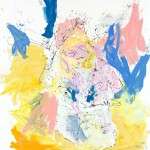
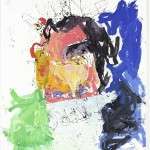
His new paintings at the Gagosian Gallery adopt the Abstract Expressionist brushstrokes and bright palette of Willem de Kooning, while the British Museum displays prints from the early Sixties and Seventies, alongside the graphic works of five postwar German contemporaries. The third outing opens this week at the Royal Academy with a selection of 16th-century Renaissance and Mannerist chiaroscuro woodcuts from Baselitz’s personal collection, a collection that’s had some influence on the artist’s own style and printmaking technique.

TEFAF Art Market Report Says 2013 Best Year on Record Since 2007, With Market Outlook Bullish

The global art market outlook for 2014 is extremely bullish, according to the latest TEFAF Art Market Report published today by the European Fine Art Foundation. Prepared by Dr. Clare McAndrew, the much anticipated annual report tracking global art market movements says 2013 was the best year on record, other than 2007, and only just shy of that year’s record totals. The report confirms the flagging Impressionist and Modern art market of recent years, with Post-War and Contemporary sales continuing to dominate the market.

Here are 10 of the key conclusions from the Report.

Carolee Schneemann: ‘I never thought I was shocking’

In 1968, Carolee Schneemann caused outrage in Britain simply by giving a talk about art. “I wore farmers overalls,” she says, “and I had lots of oranges stuffed everywhere. It was about Cézanne, so I showed slides and talked about his influence – and I kept undressing and dressing. I was naked under my overalls and I’d throw these oranges into the audience, like a still life escaping. Then I’d do my overalls back up and continue the lecture.”

The audience, at the ICA in London, did not appreciate the 29-year-old artist’s approach. “They went a bit nuts,” Schneemann recalls. “They were outraged, ‘This is infuriating! What does this mean? How can she be naked and talk about art history?’ But that was the point.”

Georg Baselitz: Farewell Bill, Gagosian Gallery, review

At the Gagosian Gallery in King’s Cross, one Hans-Georg Bruno Kern, who changed his name to Baselitz after the Saxon village of Deutschbaselitz where he was born in 1938, also presents Farewell Bill, a suite of impressively large and loose self-portraits in honour of the great Abstract Expressionist painter Willem de Kooning.

If Baselitz is known for one thing, it is for his decision in 1969 to flip his paintings upside down, so that his subjects appear inverted. In doing so, he wanted to achieve a tension between naturalism and abstraction. Confronted with one of his paintings of, say, a topsy-turvy face, we tend to see it first as abstract marks, before craning our necks to “resolve” the image as a portrait.

Why has looking at art in Britain become a snob’s rite of passage?

To have “taste” in art and know a bit about it is part of the battery of glib accomplishments that mark out the elite from ordinary folk. This hateful art snobbery has nothing to do with a true love of art – it is just about being able to talk the talk.

The French sociologist Pierre Bourdieu produced a frightening analysis of culture and class. In his book Distinction he showed that in France when he was writing, cultural attitudes mirrored social positions not just broadly but minutely – for instance, people at the very top of the elite with the greatest “cultural capital” were more likely to like minimalism.

Oscar Puts Steve McQueen Beyond Contemporary Art

Indomitable. That’s how Brad Pitt described Steve McQueen during the Oscars Ceremony last night, when 12 Years a Slave—the harrowing story of a man sold into slavery, co-produced by Pitt and directed by McQueen—won Best Picture award. McQueen is no doubt a film force to be reckoned with, embraced and feted by Hollywood. And it’s within Hollywood that the artist has found the platform he was looking for.

On the Money at the London Auctions

The truth of the art market is that art sells better at auction than it does in the galleries. This is primarily due to the “new buyer” phenomenon, which for the time being is what rules the day. All hail the rule of the auction season! Here’s my take on the recent sales in London. – Adam Lindemann

Adapting The Armory Show: Noah Horowitz on Mixing Art and Business

The first week of March has become, thanks to The Armory Show and Armory Arts Week, the true kick off of the spring art season. Art fairs have increasingly become the key meeting place for galleries and collectors, a trend that benefits The Armory Show. Under the leadership of Executive Director, Noah Horowitz, the fair has worked to maintain the integrity of each gallery showing within the walls of Piers 92 and 94, while embracing the changes in the ever-shifting art world.

Horowitz joined the team at The Armory Show in the fall of 2011, when the future of the fair was somewhat unclear. London-based Frieze Art Fair announcing that they would expand to New York in 2012, and a layer of uncertainty surrounding the ownership of The Armory Show itself, created a degree of questioning within the institution that had produced a long run of successful shows since its formation in 1994. Horowitz, who has a Ph.D. from the Courtauld Institute of Art in London, where he studied art and business, was first approached by Paul Morris, one of the founders of The Armory Show, and Debbie Harris, who oversees the Modern section of the fair.

The Case of the “Million-Dollar” Broken Vase

When a local artist intentionally shattered a vase, last week, at the Pérez Art Museum Miami’s ongoing Ai Weiwei retrospective, most journalists predictably focussed on the price of the destroyed work, which was said to be a million dollars. CNN’sheadline was typical of the coverage: “MIAMI ARTIST DESTROYS $1 MILLION AI WEIWEI VASE IN PROTEST.” Variations of this appeared in the Guardianthe Associated Press, and on Gawker, as well as in magazines and local newspapers.

Ai had painted the Han Dynasty-era vase to resemble a cheap modern-day container, an example of his long-standing interest in notions of cultural heritage, authenticity, and—appropriately enough—the value of art. It’s not surprising that media coverage led with the price, rather than by focussing on these more rarefied qualities. What is surprising, however, is that the much repeated price was almost certainly wrong. There is scant evidence that the vase, which was on loan from the artist and had never been auctioned or sold, would sell for anything close to a million dollars. An official appraisal by the museum’s insurers is still in progress, but, according to Leann Standish, a deputy director at the museum, they will most likely determine that the vase is worth much less. How the million-dollar figure came to be, and how it subsequently spread online and in print, says a great deal about the contemporary art market, and about the ephemeral relationship between a work of art and its dollar value.

Build it … and they will show

David Roberts is an art-world oxymoron: a property developer who collects art and almost never sells, a businessman worth more than £80m who doesn’t see art as an asset class. As one of Britain’s most significant contemporary art collectors and founder of the charitable David Roberts Arts Foundation (DRAF), Roberts is a major presence on the international art scene, but he is quite unlike the 21st-century breed of High Net-Worth Individuals who stalk the aisles ofFrieze art fair or Art Basel Miami Beach, snapping up brand art and berating helpful gallery assistants. (“I don’t care if the artist is black or lesbian, the back story doesn’t interest me,” I heard a man shout at a young gallerista during last year’s Frieze.)

Santiago Sierra & Jorge Galindo’s collaboration: Unofficial motorcade – Video

WASHINGTON, DC.- Santiago Sierra (Spanish, b. Madrid, 1966; lives and works in Madrid) and Jorge Galindo (Spanish, b. Madrid, 1965; lives and works in London) organized an unusual motorcade along one of the most prestigious thoroughfares in the Spanish capital in August 2012. Seven black Mercedes-Benz sedans made their way down the Gran Vía, each car incongruously topped with an upended monumental portrait of King Juan Carlos I or one of the six prime ministers of the Spanish democracy. Running Feb. 14 through May 18 at the Smithsonian’s Hirshhorn Museum and Sculpture Garden, “Black Box: Santiago Sierra and Jorge Galindo” presents “Los Encargados [Those in Charge]” (2012), the six-minute single-channel video the artists made of this event.