Ai Weiwei: UK Galleries Play Host To Important New Summer Exhibitions

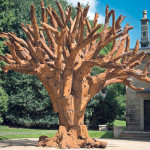
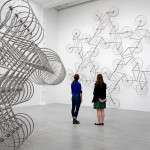
Two exhibitions of new work by the Chinese dissident artist Ai Weiwei have opened in the UK. The first at a public art gallery in Yorkshire (Yorkshire Sculpture Park (YSP) is his first in a British public gallery since Sunflower Seeds at Tate Modern in 2010. iron tree, 2013 is a majestic six-metre high sculpture is presented in the chapel courtyard, while the installation Fairytale-1001 chairs, 2007-14, is  presented inside the chapel with two other works: the porcelain Ruyi, 2012, and marble sculpture, lantern, 2014, which makes its premiere in the UK. The sculptures shown within the chapel relate to ideas about freedom and to the individual within society, whilst also connecting with the history and character of the building.

Three current Ai Weiwei exhibitions display his wit and courage

Yorkshire Sculpture Park has a strange new tree. Solid yet graceful, inspired by the street vendors of Jingdezhen in southern China, who sell wood for its beauty, “Iron Tree” (2013) is a collection of fragments held together with bolts. It seems to have been in the wars, this tree, much like its maker Ai Weiwei.

Planted in front of the park’s newly restored chapel, the six-metre high sculpture is the first thing you see in an exhibition the Chinese artist has worked on from afar. Ai can’t travel outside China – his passport was confiscated after his arrest in 2011 – so plans and photographs have bounced across the net. As a result, 45 of the 1,001 Qing dynasty chairs Ai used to represent Chinese citizens at the 2007 Documenta in Kassel have been positioned inside the chapel, along with three other works. Visitors are invited to sit on the chairs, contemplating their scuff marks and their history.


What Makes an Art Capital?

How do Dubai, Istanbul, or Hong Kong differ from the “traditional” hubs of London and New York? How can artistic activity and its economic corollaries be encouraged? Such were the questions put to a panel chaired by the indefatigable art market expert Georgina Adam at Christie’s London on May 27.

Art Dubai director Savita Apte, art critic Louisa Buck, artist Michael Craig-Martin, and Hayward Gallery director Ralph Rugoff discussed the “ingredients” necessary to turn a city into a global art center—one which nurtures and serves a homegrown scene as well as attracting the nomad flock of contemporary art professional aficionados.

Here’s what you need to know…


Contemporary art isn’t original – even copying has been done before

The row around Marina Abramović is redundant, as the story of art is one of homages and remakes. But that’s not to say there isn’t a problem.

“Good artists copy, great artists steal,” said Pablo Picasso. Or at least he gets the credit for saying it. Perhaps he pinched the words from Oscar Wilde. For there truly is nothing new under the sun, or not entirely new, anyway. Originality does not burst from an artist’s head like an alien entity, but is a subtle game of variations and transformations out of which, once in a while, comes the shudder of true artistic surprise.

A group of art intellectuals who have questioned the originality of a performance to be staged by Marina Abramović at the Serpentine Gallery this summer has strayed into very silly territory. They are wrong about the very nature of art, and the way it changes through time; its history. This is bizarre, because the people making the fuss are professional art historians. They insist Abramović should acknowledge a previous work by the American artist Mary Ellen Carroll, which they say has a prior claim to her chosen theme. In a surreal twist that theme happens to be “nothing”.


9 Things You Didn’t Know About Dada Master Marcel Duchamp

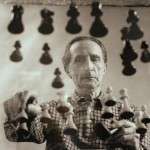
“I force myself to contradict myself in order to avoid conforming to my own taste,” proclaimed Marcel Duchamp, Dada master and the man behind everyone’s favorite urinal.

The phrase only begins to explain the versatile, zany and ever-evolving works of the French-American artist, famously known for “The Fountain,” his 1917 pièce de résistance that will go down in history, according to the BBC and a panel of 500 experts, as the most influential artwork of the 20th century.


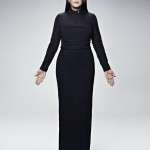
Art star Marina Abramović caught up in row over ‘Nothing’

A group of curators and art historians have argued that the Serbian artist’s latest performance piece, due to open at London’s Serpentine Gallery on 11 June, fails to acknowledge the influence of another artist’s earlier work.

A prestigious group of curators and art historians have written to the gallery questioning why Abramović’s latest performance piece – due to open 11 June and about which she has repeatedly emphasised the importance of “nothing” – fails to acknowledge the influence of another contemporary artist who has also made “nothing” central to her work.

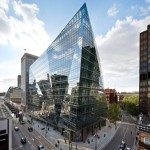
Shardenfreude: London’s copycat craze is crystal clear

The Shard has spawned a host of angular glassy lumps across the capital. But is this new crystal city full of Shardettes a welcome change?

When Renzo Piano casually described his design for London Bridge Tower in a press conference as “a shard … a shard of crystal,” he must have had little idea what his poetic aside would unleash. Thrusting above the city as a crystalline spear, the Shard has spawned a host of mini-Shards and Shardettes, as architects and developers have rushed to emulate its sharp-edged glamour. London is now peppered with fractured cliffs of mirrored glass, twisting and folding in all directions. It is as if the splintered top of the Shard was the result of some momentous collision – its peak blasted into smithereens and showered down in faceted fragments across the capital.


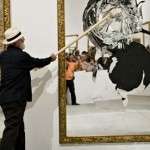
Michelangelo Pistoletto: the artist with a smashing way to save the world

Pistoletto shook up the 60s with his arte povera revolution. What’s the legendary mirror-smasher doing now? Designing houses made of rice at his eco HQ.

Born in Biella in 1933, Pistoletto grew up under fascism. “You had to believe – in God and in Mussolini. I felt there was a terrible contradiction in believing in a system producing hate, producing massacres. After the war, Italy saw the rise of both capitalism and communism. You had to believe in one or the other. Discovering modern art was, for me, an illumination. Now I could think rather than believe.”

After 1945, Italian culture embraced realism. It was as if all the lies of the Mussolini age could be purged only by a harsh blast of pure truth. In cinema, this led to the likes of Rome, Open City and The Earth Trembles (La Terra Trema). Meanwhile, the 17th-century realist painter Caravaggio was rediscovered – and a young artist called Michelangelo Pistoletto started to appropriate mirrors, painting directly on to their surfaces. “Everything in my work has come from the mirror,” he says, “and the idea that it reflects society and reality.”


Watch the Video!

Tracey Emin’s My Bed is up for sale at what may be a dream price to some

The furore around the work, complete with vodka bottles and pregnancy tests, helped to give lift-off to Emin’s career.

Few pieces of art have divided opinion quite like My Bed – in whichTracey Emin claimed to have spent a week after a bad break-up.

Complete with vodka bottles, cigarette butts and pregnancy tests, the installation didn’t win the Turner prize during the year of its entry in 1999; she lost out to another young Londoner by the name of Steve McQueen.  Nevertheless, the furore helped to give lift-off to Emin’s career as one of the most successful British artists of her generation, sparking a media frenzy and causing visitor numbers to the Tate Britain to hit record highs.

Fifteen years on, it can be yours for an estimated price of between £800,000 and £1.2m.


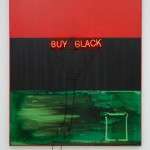
Curator Nicola Vassell on Her New “Black Eye” Show, and Why the Art World Stays So White

There are two shows currently taking place in New York that regard Obama as a touchstone. The first is Michelle Grabner’s festive floor at the Whitney Biennial, where the president stares with distinguished self-possession into the lens of photographer Daywoud Bey. Young and commanding, this is Obama before the announcement of his candidacy in 2008. The moment marks a progressive direction forward for the country, and, serving as a mantle above Grabner’s curatorial text, for American art today.

Downtown, another show called “Black Eye” at 57 Walker Street curated by Nicola Vassell, the previous director of both Pace Gallery and Deitch Projects, also evokes the age of Obama. But unlike Grabner, Vassell is not tapping into the dewy optimism that accompanied Obama’s first inauguration. Instead, she cites his sobering reelection in 2012 as the show’s genesis: the second time around, she recalls, there was still pride, but also a diminishment of expectations. The crush of the political system in Washington had stamped out the nation’s sense of unfettered possibility.


Ai Weiwei, Lisson Gallery

Ai Weiwei’s activism and his 2011 detention by the Chinese state have made him one of the world’s best-known artists but can you picture his work? Google him, and his portrait, not his art, dominates the images that appear.

This is a useful reminder that he’s a top conceptual artist, with a knack for finding a potent balance between a striking and often enigmatic image or object and hard-hitting social and political themes.


How Does Richard Prince’s Notorious “Canal Zone” Look 6 Years Later? Like Freedom

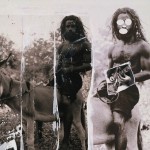
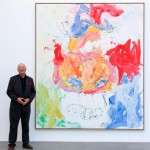
Is there anything left to say about Richard Prince‘s notorious “Canal Zone” paintings and their attendant legal controversy? The case was finally settled, leaving its effect on copyright law uncertain. Art-world scolds who railed against Prince’s appropriation of photographer Patrick Cariou’s Rastafarian images have moved onto new causes. The dozen or so pictures, looking as if some of them might be new but all dated 2008, are now on view at Gagosian Madison Avenue, filling both the main sixth-floor gallery and the long, tall space on five.

With the legalities out of the way, we can ask another question. How do the pictures look now? In a word, they look hot.

What Did Duchamp Do? A Survey of the Founding Modernist’s Most Radical Artistic Achievements

For a cynic, the biggest takeaway from Duchamp’s legacy might be that, since his death in 1968, no artist has done anything new. Which would, in part, be true: Duchamp’s impact on art could be compared to Einstein‘s on physics, with all ongoing developments simply elaborations of his foundational principles. But that aside, for the artists who came after him, citing Duchamp suggests a certain attitudinal sense of humor with a biting intellectual edge.

So what, exactly, did Duchamp do? Those whose knowledge of his achievement stops with his famous Nude Descending a Staircase, No. 2 (1912)—a early painting in a definitively Cubist style—will be surprised to know that the iconoclastic Frenchman continuously exploded one convention after another over the course of his long career. To better understand exactly what Duchamp wrought, we took a look at his greatest hits—and how they continue to chart new directions for art today.


Edge of the Seat: The Artist’s Chair

From the suggestive to the precarious, a new exhibition casts the humble chair in a new light, writes Louisa Buck.

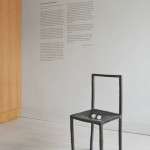
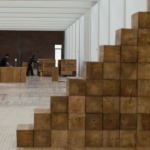
Q: When is a chair more than just a chair? A: When it is an artist’s chair. It is a truth, universally acknowledged, that sculpture can be experienced as much by the body as in the mind, and nowhere is this truth more evident than in Large Glass’s deftly-curated show devoted to artistic responses to the chair, that most familiar resting place for our human form. For while you may not be able to sit on this multifarious array of sculptural seats made by some of the leading names in art and design, the bodily frissons nonetheless come thick and fast.


Alcatraz Tickets Expected to Become Scarce During Ai Weiwei Installation

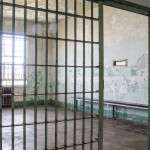
Due to an incoming and highly anticipated art exhibit, Alcatraz prison may be harder to get into than out of this fall. Sure, seats are always hard to get on the Alcatraz Cruises ferry, despite the 17 departures a day from Pier 33 in San Francisco. But empty seats may become an even scarcer commodity come Sept. 27, when an installation by art superstar Ai Weiwei opens on the island.Al


Fun Frieze Week Guide – NYC 2014

BAC is off to Frieze NY for the 3rd instalment of this excellent Fair (hopefully it will be a little less, ah, dramatic, this time…).  Lots of other things are happening in New York at the same time, including the “satellite” Art Fairs: NADA, PULSE, and even “outsiders” are invited, to the Outsider Art Fair.  Attached is artnet News’ list of 10 Art Fairs you can attend.

In addition, Christie’s, Sotheby’s and Phillips Auctions will have previews later this week for their major contemporary art sales next week, and the Galleries, public and commercial, have some great exhibitions up – it is New York, after all!

Should be fun!!

Whitney Edits a Tale of a Nation

A year away from opening, the new home of the Whitney Museum of American Art is still a construction site, but it is already a vivid presence in Manhattan’s meatpacking district, and curators have mapped out months’ worth of exhibitions there.

The first show to go on view next spring — an opening date has not yet been set — will tell the story of 20th- and 21st-century American art entirely through the Whitney’s permanent collection. It will include many prominent favorites: Alexander Calder’s “Circus,” Edward Hopper’s “Early Sunday Morning,” Andy Warhol’s “Green Coca-Cola Bottles,” Georgia O’Keeffe’s “Music Pink and Blue No. 2,” Jasper Johns’s “Three Flags.” There will also be plenty of work by artists of later generations — Cindy Sherman, Richard Prince, Kara Walker — who are “now considered pillars of contemporary art,” said Donna De Salvo, the Whitney’s chief curator.


Out of Site: Finding Robert Smithson’s New Jersey

Montclair show tours the land artist’s Garden State legacy.

On a frigid morning this past winter, the art historian, critic and curator Phyllis Tuchman was guiding her blue Mercedes sedan through the desolate parking lot of a shopping plaza in Bayonne, N.J., past a Super Stop & Shop, a Starbucks and a Houlihan’s, toward an inlet of the Hudson River.

“God, I can’t believe I’m doing this,” she said, as she nonchalantly ignored the markings for parking spots in an attempt to avoid birds that were lounging in front of a tanning salon. “I’m very New Jersey,” she said. “It’s embarrassing.”