
10 of Art History’s Most Important (and Now Defunct) Galleries

As a business model, the art gallery occupies a unique position. Functioning as the bridge between art’s existence as a commercial enterprise and its role as a philosophical pursuit, a gallery, unlike other businesses, has a measure of success that is completely divorced from its financial earnings: by championing important artists, and putting on daring and provocative shows, they can become part of art history even if they never generate a massive profit.

On the one hand, this is a good thing, since it means that galleries can handle the commercial side and leave the artist to do what they do: make interesting art. On the other hand, it means that even historically significant galleries art don’t always make it past their first year of existence. This might be for fiscal reasons, or due to shifting audiences—or, in some cases, a successful gallery’s operator simply decides to move on. Below are 10 galleries that each made a major impact on art, but, for various reasons, didn’t last.
 

Jeff Koons, Kara Walker, and the Challenge of Public Art

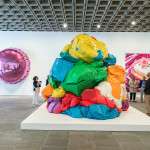
As if his museum-filling Whitney retrospective weren’t enough, Jeff Koons currently has a massive sculpture on view at Rockefeller Center. “Split-Rocker,” presented by Gagosian Gallery and organized by the Public Art Fund and real estate developer Tishman Speyer, is comprised of two halves, one the recreated head of a toy pony rocker that belonged to his son, the other the head of a toy dinosaur rocker. Each side is made out of steel and covered in flowering plants. They are brought together imperfectly, and where the edges of one don’t quite align with the edges of the other, you can peek inside to see the tubes of a sprinkler system.

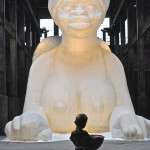
Gazing up at “Split-Rocker” on the day of its opening last week, I found myself thinking about Kara Walker. In the dark, dank space of the old Domino Sugar Factory on the Williamsburg waterfront — quite far, although not too far from the touristy crowds of Rockefeller Center — she has also installed a work of public art: “A Subtlety,” a gigantic sculpture of a mammy-as-sphinx made out of sugar, presented by Creative Time. And though Koons and Kara are about as far apart as two superstars of contemporary art can be, their current public installations have remarkable overlap.


Use your imagineering: Ryan Gander’s art world of pranks and puzzles

Eyes in the wall, coins glued to the floor: Gander’s new show at Manchester Art Gallery is full of spoof and childish wonder – he’s having a laugh, but is it at our expense?

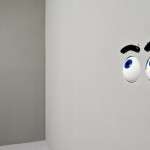
The eyes swivel and follow me round the room, blinking with an echoing clack! Insouciant eyebrows are raised then furrow with a cartoonish human semaphore as I go from work to work, in Ryan Gander’s show at Manchester Art Gallery. Feeling the eyes boring into my back, I pretend to concentrate. Thank God a room full of Rembrandts doesn’t give you looks like this, portraits waggling their eyebrows as you pass.

Embedded not in a face but a blank wall, the eyes are animatronic, and connected to motion sensors. The eyebrows do a random dance all their own, signalling curiosity, surprise and worry. Maybe the eyes are a kind of self-portrait. They’re having a gander, innit.


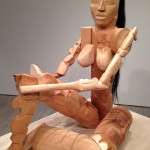
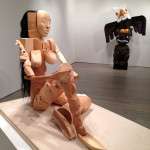
Odalisque like you’ve never seen her before – Shawn Hunt

When I first saw Odalisque at Artifake, I found it difficult to look at her. So rather than do that, I wandered off to look at the other works in the gallery as I thought about what so upset me about her.

In part it was her gaze and her powerfully strong posture. But mostly it was how she looked. Like most people in Vancouver exposed to Northwest Coast art, I’m used to seeing highly crafted and beautiful masks, totem poles and bent boxes. Odalisque, however, is rough and unfinished: I could see pencil marks left by the artist on the wood.

Odalisque was playing havoc with my neat categories. As someone with no First Nations ancestry, I’ve always recognized Northwest Coast art as being from someone else’s tradition. Odalisque was something new. She was someone I’d met before but never in an art gallery. If I’m an outsider in relation to most Northwest Coast Art, Odalisque made me feel more of an insider. I felt as if I saw part of myself in her. She got under my skin in a way that made me uncomfortable.

But since our first meeting, I’ve come to like Odalisque quite a lot. – Kevin Griffin


Critical Reduction: Jeff Koons at the Whitney

Can money buy critical immunity? It certainly seems so, judging by critics’ response to the Whitney Museum’s retrospective devoted to the most expensive living artist,Jeff Koons. In this week’s edition of Critical Reduction, we boil down eight critics’ takes on the shiny extravaganza, which, befitting of such a divisive artist, tend to be either vividly enthusiastic or vehemently dismissive. (For artnet News’s takes on the show, see Ben Davis’s review here, and Blake Gopnik and Christian Viveros-Fauné’s video review here.)

10 Game-Changing Auctions

Art Basel and the London summer auctions are behind us, and the auction market continues to hit unprecedented peaks. But today’s records and art stars came straight out of yesterday’s headline-grabbing auctions. With that in mind, we take a look back at some major milestones of the last few decades—from the 1973 sale that arguably lit the fuse on the current contemporary market to the recent three-quarters-of-a-billion dollar total of a single evening—to see how these 10 auctions changed the game and perhaps what might happen next.

The ABCs of Sol LeWitt’s Art

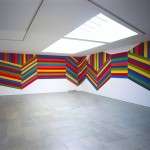
No one could blame you for expecting conceptual art to be cold, impenetrable, and impassive; nor for noticing that the genesis of conceptualism, which pared the artwork down to its most basic forms, only shortly preceded the general explosion of the art market in the West. Rising prices, ironically, seem to have coincided with diminishing forms. One could be forgiven for feeling somewhat cynical about this fact. But Sol LeWitt‘s work is a buooyant reminder of the way that apparent simplicity often shrouds the real work of the conceptual work of art—the work done within the artist’s mind; the labor of conception, translated through an artist’s programmatic treatment into simple lines, colors, and shapes.

President Vladimir Putin signs legislation banning swear words in art, films

MOSCOW (AFP).- A hugely controversial Russian law banning curse words in films, theatre, the media and arts came into force on Tuesday, part of a Kremlin-backed drive to play up traditional values and root out swearing. The legislation, wich was signed off by President Vladimir Putin in May, imposes hefty fines on offenders — up to 2,500 rubles ($72) for individuals and up to 50,000 rubles ($1,460) for businesses.

Galleries close in protest 😉

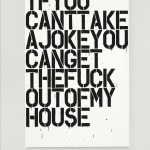
Vladimir Putin Bans Cursing in Art

Vladimir Putin is telling artists and filmmakers to wash their mouths out with soap—or pay the price. A law that went into effect on Tuesday mandates that creatives whose work includes obscene language pay finesup to 2,500 rubles ($72) for individuals and up to 50,000 rubles ($1,460) for businessesaccording to the AFP.

Jeez, there goes a lot of the art we like …

Performance: do you buy it?

The public is warming to the medium, but collectors remain cool.

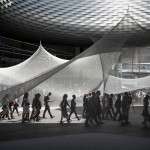
While some visitors spent the first public day of Art Basel admiring multi-million-dollar paintings, others strayed from the main fair to watch a nude woman examine her body with a hand mirror and a war veteran stand silently in a corner. These performance works, by the artists Joan Jonas and Santiago Sierra respectively, are part of “14 Rooms”, a show of live installations at Messe Basel (until 22 June). The project is part of a wider effort to raise the public’s awareness of performance art.

“Performance is reaching a broader public now,” says Hans Ulrich Obrist, the co-director of the Serpentine Galleries in London, who co-organised “14 Rooms” with Klaus Biesenbach, the director of MoMA PS1 in Queens, New York. “The internet age has made the need for live experiences more urgent.”

Manifesta 10 Succeeds Despite Controversy

Manifesta 10 opens at St. Petersburg’s State Hermitage Museum this Saturday. To some—likely the roaming art biennale’s curator, Kasper König, among them—that sole fact is accomplishment enough. Since König signed on to head up the exhibition, much has changed on the ground in Russia: a swath of anti-gay legislation and censorship, and the Kremlin’s growing expansionist tendencies with the annexation of Crimea and alleged continued involvement in unrest in eastern Ukraine principle among other issues. König and Manifesta director Hedwig Fijen have remained optimistic, however, attempting to use the platform as a means to transcend the current geo-political wrangling. Art, they’ve repeatedly posited , cannot fall prey to politics. 


“Jeff Koons: A Retrospective”

If I had to sum up American history in a word, I wouldn’t use racism,though obviously that’s a biggie. I’d pick hokum. I put it right up there withliberty, as in “life, liberty and the pursuit of happiness,” a passage which itself could be taken for hokum, written as it was by a man who owned slaves.

However, I don’t mean the term as it’s generally construed, i.e. bullshit. I refer to this definition: “A device used (as by showmen) to evoke a desired audience response.” As embodied by the oratorical sleight of hand that has sold Americans on everything from snake oil to unprovoked war in Iraq, hokum provides the filling for our proverbial apple pie, baked into such rhetoric as “manifest destiny,” “the lost cause” and “morning in America.” Hokum is also why I think Jeff Koons is the quintessential American artist: His work is a concrete expression of the idea.


Slideshow: The Jeff Koons Retrospective

Art is a “platform for the future,” Jeff Koons announced at yesterday’s press conference at the Whitney. What that means is anyone’s guess, but he followed that up by explaining that he’s 59 and hopes to be making art for at least another three decades. In short, while this may be his first New York retrospective, it won’t be his last. The retrospective opens this Friday, June 27th, and runs until October 19th, and will include work from 1978 through 2014.

Koons’s work is known to be divisive, so there are many likely to take issue with that perspective. Readers can come to their own conclusions by clicking through our preview slideshow and visiting the show at the Whitney once it opens this Friday.

Shapes of an Extroverted Life ‘Jeff Koons: A Retrospective’ Opens at the Whitney

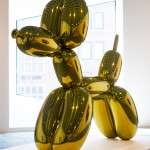
There are so many strange, disconcerting aspects to Jeff Koons, his art and his career that it is hard to quite know how to approach his first New York retrospective, the Whitney Museum of American Art’s largest survey devoted to a single artist.

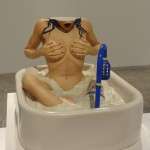
First there are the notorious sex pictures from his “Made in Heaven” series of 1989-91, big paintings printed in oil inks on canvas that depict the artist in stagy foreplay, and beyond, with his wife then, the angelic Ilona Staller, known in her porn-star days as La Cicciolina. There is the automaton-like presence of the artist himself, as freakish as Andy Warhol, but far wordier, seemingly more extroverted and given to a slightly nonsensical Koonsspeak that casts him as the truest believer in a cult of his own invention. Like his art, he is completely sincere.

Despite some ups and downs, this is a gripping show. It chronicles a sculptural career that is singular for its profusion of color, crafts and materials; its opening up of historical avenues closed by Minimalism; and its faith in both accessibility and advanced art, that other New. And it’s a great way for the Whitney to decamp, tossing the Met the keys, knowing that we won’t soon forget that it still owns the place.


Taking in Jeff Koons, Creator and Destroyer of Worlds

It’s all helixed into this: something fantastic, something disastrous. “Jeff Koons: A Retrospective” is upon us. One can’t think of the last 30 years in art without thinking of Koons, a lot. I’ve witnessed this career from very close range. I have seen him transform himself into the Koons hologram we know now; him polishing sculptures late at night in galleries before and during his shows; not selling his work; almost going broke; charging less for a sculpture than it cost to produce. In a Madrid club in 1986, I watched him confront a skeptical critic while smashing himself in the face, repeating, “You don’t get it, man. I’m a fucking genius.” The fit passed when another critic who was also watching this, the brilliant Gary Indiana, said, “You are, Jeff.” I agreed.

No, Koons is not “our Warhol,” as so many claim. Warhol’s complex aura changed everything, whereas Koons is cheery, centerless, more of a bland Mitt Romney Teletubby than a mysterious force of nature.

READ THIS ARTICLE.

Material Boy: Jeff Koons at the Whitney

Given that he’s a goliath figure in the art world whose output spans three decades, it may come as a surprise that Jeff Koons’s Whitney retrospective is the artist’s first major solo show at a New York museum.

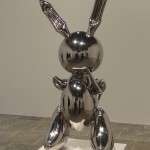
The exhibition offers 150 works dating back to 1978, giving visitors a comprehensive look at the former commodities trader’s ambitious and diverse artistic output. Everything about Koons and his oeuvre seems overwhelming, from the scale of the works to the (apparent) complexity of the execution: Koons famously consulted with Nobel Prize-winning physicist Richard Feynman to determine the proper saline mix to suspend basketballs in solution for his 1985 Equilibrium series. “Walrus (Blue Green)” (1999), a work that appears to be a simple colored mirror, lists six distinct materials including carbon fiber.


Whitney Curator Scott Rothkopf on How to Understand Jeff Koons’s Artistic Achievement

A titanic presence in American postwar art, Jeff Koons is an icon whose popular fame, instantly recognizable sculptures, and consistent status as the most expensive living artist ensure that he will be remembered for a long, long time to come. And that’s not even considering their value as works of art, an appraisal that will have its most fulsome expression to date in Koon’s long-anticipated career survey opening at the Whitney Museum this week—the first time that the artist’s extremely diverse and challenging series will all be displayed in the same place at the same time. The first single-artist show to fill the Whitney’s beloved Marcel Breuer building before the museum moves to a new state-of-the-art space downtown, the exhibition is certifiably one for the history books.

A Shadow Market at Art Basel

BASEL, Switzerland — Art Basel, the world’s pre-eminent fair devoted to modern and contemporary works, opened its doors to V.I.P.s on Tuesday. But by then plenty of business had already been done by many of the 285 exhibiting dealers. Hundreds of thousands of digital images had been emailed to collectors, advisers and curators, giving them the opportunity to reserve or even buy works before the official opening of the event in Switzerland.

“Jpeg bombing,” as we might call it, has subtly changed the dynamic of Art Basel and other contemporary fairs. Back in the mid-2000s, during the last contemporary art boom, Armani-clad collectors would actually run into V.I.P. openings, desperate to have first dibs on the latest available works from the studios of Damien Hirst, Jeff Koons, Takashi Murakami and other fashionable artists.


Shawn Hunt, Conquering fear.

The lighting in this long and cavernous atelier is quite dim—the only light stems from a large lamp shining on the paintings of First Nations artist Shawn Hunt—emotive, beguiling fusions of dimension and colour.

“What I’m trying to do is continue the long line of creating art that my people have done over the years,” explains Hunt. Since graduating from the University of British Columbia’s Fine Arts program in 2000, Hunt has had an impressive career spanning jewellery making, sculpture, and most recently, painting. “I’m creating art using traditional elements and motifs, and even traditional methods of making things, but I’m living now, and dealing with modern issues.”


Jeff Koons as the Art World’s Great White Hope

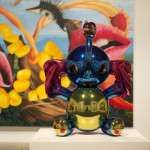
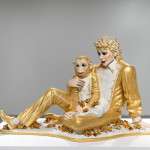
Midway through the Whitney Museum’s Jeff Koons retrospective, you come upon “Banality.” The series, unveiled in 1988 at three galleries concurrently (Sonnabend in New York, Donald Young in Chicago, and Max Hetzler in Cologne), made Koons the neo-Pop god that he is today. It consists of a series of man-sized kitsch figurines.

“In my ‘Banality’ series I started to focus on my dialogue about people accepting their own histories,” he said later. “I was just trying to say that whatever you respond to is perfect, that your history and your own cultural background are perfect.” This is typical of Koons’s self-help-ish patter of positivity, though also actually sharper than most of Koons’s pronouncements in acknowledging that there are other cultural backgrounds.

Today, Jeff Koons dominates the center of the art conversation as no one else does. His ideas about turning off your critical mind so infuse the system that the Whitney repeats his bizarre, tone-deaf thoughts about race without even seeming to find them that troubling. Which shows that his universal shtick is an illusion: He speaks both to and from a specific place, and it’s dangerous to forget that.