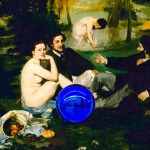
Jeff Koons on his Gazing Ball Paintings: ‘It’s not about copying’

The artist’s new show presents repainted versions of masterpieces, from Titian’s Venus and Mars to the Mona Lisa, with a shiny blue sphere placed in front of each.

Standing in front of the Mona Lisa – only this version was around three times the size of the original and had a blue sphere on a shelf that jutted out from the painting – the artist Jeff Koons noted that he wasn’t the first artist to reinterpret Leonardo da Vinci’s masterpiece.  Marcel Duchamp and Andy Warhol had also appropriated the painting, he pointed out – Duchamp by drawing a moustache on a reproduction of the image for his famous 1919 work LHOOQ.

Koons has gone further, however. In his new show at the Gagosian gallery in New York, the artist has taken 35 masterpieces, including Manet’s Déjeuner sur l’Herbe, Géricault’s Raft of the Medusa and Rembrandt’s Self-Portrait Wearing a Hat, had them repainted in oil on canvas, and added a little shelf, painted as if it had sprouted directly from the image.


Why Does Art History Have the Blues?

Why do artists always seem to have the blues? Since time immemorial, blue has held a special place in art history, evoking the loftiest sentiments, the most aristocratic pedigrees, and the profoundest spirituality. As a material, blue pigment has itself been a fetishized commodity, serving as everything from a prized color for Medieval monks to the point of obsession for the painter Yves Klein. Many artists have tried to explain the hue’s allure—Fauvist painter Raoul Dufy once said, “the only color which maintains its own character in all its tones,” for instance—but, in fact, blue has had a wide spectrum of meanings over time. Here are five ways the color has been used throughout art history.

Antony Gormley to confront Hong Kong’s raw nerves by placing sculptures on its rooftops

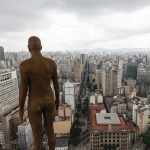
Just over a year ago, thousands of pro-democracy protesters took over Hong Kong’s busiest thoroughfares. This month, 31 life-sized naked bodies made by Antony Gormley fr om cast iron and fibreglass will infiltrate the skyline, overlooking some of the same streets. The arrival of the British artist’s Event Horizon, which is due to be unveiled on 19 November (until 18 May 2016), was delayed by more than a year after a banker jumped from a high-rise building owned by the project’s original sponsor, Hongkong Land.

In a city of auction houses, commercial galleries and art fairs, a project so accessible to the public takes on more significance. “To the degree that this is a very evident occupation of collective space, it’s a call for art to be allowed to be common again,” Gormley says.

What 5 of the World’s Riskiest Art Buys Tell Us About Collecting Art Today

As the art world braces for an estimated $2 billion fall auction season in the next few weeks, it’s no secret that the global art market is moving ahead at a rapid-fire pace. The stakes appear higher than ever with an unprecedented number of seven-, eight-, even nine-figure works on the auction block. While headlines frequently trumpet enormous prices for masterpieces that appreciate at stunning rates over years or decades, there are also plenty of inherent risks involved when dealing with such pricey individual objects. Read on for artnet news rundown of  some of the biggest pitfalls and common risks facing art buyers today.

Jeff Wall: ‘I’m haunted by the idea that my photography was all a big mistake’

He provokes anger, awe and huge prices for his controversial staged scenes of hostage situations and homeless shelters. The pioneer of ‘non-photography’ talks cliches, creative freedom – and his regrets.

“In my time, I’ve been accused of being afraid to go out into the world to take pictures, like a so-called ‘real’ photographer does,” Jeff Wall tells me, smiling. “And I’ve been accused of making art with a capital A – as if that, too, was a crime.”

Walking around his big, bright new exhibition at the Marian Goodman Gallery in London, it is hard to see why these suspicions of Wall’s elaborately staged images still linger, 37 years after they first went on show.  For all his success, he sounds regretful. “Not regretful because I love photography and am still excited by it, but I’m still haunted by the idea that it was a misstep and all that followed has just been a big mistake.” A brilliant mistake, I reply, taken aback.  “I guess so,” he says, sounding unconvinced. Like his best photographs, Wall reveals just enough to keep you guessing.

Think Halloween Is Gruesome? Try Contemporary Art

In the spirit of Halloween, ARTINFO has compiled a list of nine gruesome contemporary art works that give us nightmares all year long. From David Lynch’s “Six Men Getting Sick” to Hermann Nitsch’s “Theater of Orgies and Mysteries,” we’ve covered all the bases as October 31 approaches. Read on for our full, illustrated list.

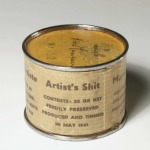
By way of example, Piero Manzoni,  “Artist’s Shit”:  “If collectors want something intimate, really personal to the artist, there’s the artist’s own shit, that is really his,” this Italian artist wrote of this work from 1961. An edition of 90, it’s quite simply a series of cans plainly labeled to advertise their contents: 30 grams of crap, presumably Manzoni’s. (The Italian — “Merda D’Artista” — makes it sound so much more refined.) Pundits have famously argued over whether this purported fecal sculpture is authentic, or a load of (metaphorical) shit.

Paddle8, Online Auction House Aims to Give Big Houses a Run for Their Money

Think of an auction house, and centuries-old institutions like Sotheby’s and Christie’s probably spring to mind.  But a four-year-old start-up believes that it can become something of an online equivalent to those companies — and it has drawn big-name backers from the art world along the way.

The venture, Paddle8, plans to announce on Wednesday that it has raised $34 million in a new round of financing. Among those participating is the New York gallery owner David Zwirner, who is joining the company’s board.

With the new financing, Paddle8 is aiming to keep expanding worldwide, tapping into what its founders say is growing global demand for high-end collectibles.

Can the Single-Venue Gallery Survive?

Notable dealers have chosen to end eponymous enterprises to join larger entities at a partnership level. Such was the case with Gérard Faggionato, who recently joined David Zwirner in London, and Valerie Carberry, who merged with Chicago’s Richard Gray last spring. Veteran contemporary art dealers Esther Schipper and Jorg Johnen are in the process of consolidating their Berlin operations.

“This idea of the independent dealer,” said Faggionato, shortly after closing his David Chipperfield–designed gallery after 22 years in Mayfair, “is a romantic one, and I understand it and like it, but maybe the reality is slightly different.” The dealer, who had handled theFrancis Bacon estate in tandem with New York’s Tony Shafrazi for a decade and sold the artist’s last triptych (from 1991) to the Museum of Modern Art in 2003, observed, “the competition is very different from what it used to be. Now everything is more about the market than individuality.”

Upon closing his Richard Gluckman–designed space in August after a quarter century at 745 Fifth Avenue, David McKee—who representedPhilip Guston from 1974 until the artist’s death in 1980, and then his estate up until recently—said, “we believed that fundamentally it was the work that should achieve its place in history, and not by promotion and hype, and we still believed it until the end. Today,” he adds, “it’s all happening too fast and it’s too market driven. The art world has become a stressful, unhealthy place.”

Alberto Burri, a Man of Steel, and Burlap

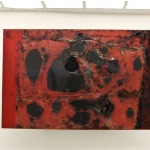
Alberto Burri’s prescient paintings — in patched, burned and otherwise abused burlap, plastic or wood — form a lavish, beautiful and admirable, if sometimes monotonous retrospective at the Guggenheim Museum. It presents an artist who is impressive less for the profundity of his work than for his consistency and his ideas, which remain very much alive even among young artists not familiar with his work.

Critics have long associated Burri’s art work with wounds, scars and various forms of destruction and decay. But for the most part he denied that his wartime experiences inspired his art works, which he emphasized were simply paintings of an unusually physical kind. Nonetheless, the war caused a dearth of conventional artistic materials that at the least brought out Burri’s inborn talent for using scavenged scraps – especially burlap – in physically imaginative, pictorially arresting ways.

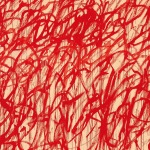
Cy Twombly makes me want to plan the art heist of the century

You can’t fault art dealer Larry Gagosian’s taste. Not only has he commissioned a spacious and elegant new art gallery in London’s Mayfair, but it opens with a Cy Twombly exhibition.

By the time Twombly died in 2011, he had become a figure of unique mystery and authority in modern art – an American who chose to live in Italy, an abstract artist fascinated by myth and history, a man who never spoke to the press, and when all is said and done, the most intelligent and emotionally eloquent artist of our age. Gagosian gave Twombly astonishing support. This artist, who painted up to the last, was able to show his final paintings, fresh from the studio, at Gagosian’s galleries across Europe and the US.

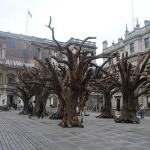
Ai Weiwei’s Tree Installation At The Royal Academy

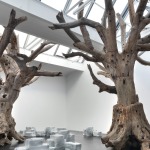
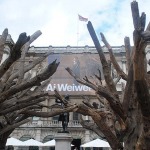
“Ai’s trees are made from parts of dead trees that are brought down from the mountains of southern China and sold in the markets of Jingdezhen, Jiangxi province. Ai transports these to his studio in Beijing where they are made into trees. As he says, “it’s just like trying to imagine what the tree looked like.

Tim Marlow, Artistic Director and co-curator of the exhibition, Added: “Ai Weiwei is one of the most important artists in the world today but his work has not been seen anywhere near as much as it should have been in the UK. This exhibition will begin to redress that balance and give an extensive new audience the chance to experience a creative phenomenon that is at once radical, political, architectural, historical, poetic, materially inventive and transformative … even before they’ve walked through the Courtyard.”

Has the Market for ‘Zombie Formalists’ Evaporated?

“No one wants to be a market darling,” an art dealer once told me.

It’s the art world equivalent of a one-hit wonder, where sudden stardom and outsize demand for a particularly hot artist creates intense pressure, and has the potential to create unsustainable spikes in his or her market and career.

Notwithstanding the fact that the particular dealer who told me this represented several certified market darlings, the recent round of mid-season New York contemporary auctions. “New Now” at Phillips on September 17, “Contemporary Curated” at Sotheby’s on September 29, and “First Open” at Christie’s on September 30 all featured a healthy sampling of buzzed-about names.

Prior to Phillips new “New Now” sale, specialist Rebekah Bowling told theNew York Times: “There seems to have been a bit of a cooling and hopefully that means we’re heading toward a market that’s more sustainable.”  Following the sale we asked Bowling for her thoughts on the overall auction: “I believe this means that we’re returning to a more rational market with less speculative activity,” she said via email.


The new reserve currency for the world’s rich is not actually currency

Here’s an interesting question: If the world’s economy is filling markets with a pervasive sense of uncertainty, why is the art market picking up steam for yet another season of what would appear to be massive sales?

 For the very rich, art is a store of value—which is not a very new idea and one reason that art is often lumped in together with gold as a safe haven from inflation. Gold prices peaked in 2011 and have been on a long slide ever since. Not art. That’s because art is also an object that provides social currency knitting together a select group of global nabobs and those who want to be seen sharing economic and cultural rank with them.
Owning art—and, if you can, owning a lot of art—provides a kind of access in today’s globally integrated social world that few other objects can provide. The few thousand serious, active art buyers around the world come into contact through transactions, on museum boards and during the endless round of global art fairs and biennials. There is no vetting committee for collectors. Money, patience and determination will get you taken seriously enough. You just have to buy art. And the auction houses, art advisers and global galleries seem more than willing to oblige.

Can art still shock in the age of the extreme selfie?Can art still shock in the age of the extreme selfie?

Marina Abramović had a gun put to her head. Joseph Beuys shared a gallery with a coyote. But with social media full of shocking images, is it worth today’s artists putting their lives at risk?

In 1974, standing expressionless beside a table in a gallery in Naples, Marina Abramović began her performance piece Rhythm 0. There was a page of instructions for the audience: “There are 72 objects on the table that one can use on me as desired … I am the object. During this period, I take full responsibility. Duration: 6 hours (8pm–2am).”

Turner Prize Sacrifices Visual Punch For Conceptual Filler In Glasgow

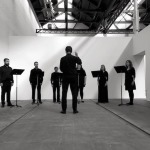
What do chorale singers, a craftsman’s showroom, a posh cafe with fur coats thrown over chairs and a library reading room have in common? Yes you guessed it – it must be Turner Prize time again! 

This year the latest nominees for this most prestigious British art prize have gone north to Scotland for the first time in the awards history. The exhibition opened at the Tramway gallery in Glasgow yesterday and Artlyst was up early for the preview. Here’s the verdict.

Artlyst Podcast: Tim Marlow And Adrian Locke Discuss Ai Weiwei At The RA

Artlyst recently attended the press view of the Royal Academy of Arts’ landmark exhibition of the Honorary Royal Academician, Ai Weiwei. Where the chief curators of this outstanding show, Tim Marlow, and Adrian Locke were kind enough to give Artlyst – and a host of other journalists – a tour of Ai Weiwei’s impressive retrospective.

The exhibition includes significant works from 1993 onwards, the date that marks Ai Weiwei’s return to China following more than a decade living in New York. The artist works in a variety of different contexts, and scales, transforming materials and meaning as part of his practice. The curators took us on a detailed tour of the artist’s detailed survey, Sadly Ai was not present at the event, wishing his work to speak for itself.

Listen to the podcast.

Artlyst Photo Special: Ai Weiwei At The Royal Academy Of Arts

The Royal Academy of Arts is currently presenting a landmark exhibition of the Honorary Royal Academician, Ai Weiwei. Although Ai is one of China’s leading contemporary artists, his work has not been seen extensively in Britain and the Royal Academy is presenting the first major institutional survey of his artistic output. The exhibition includes significant works from 1993 onwards, the date that marks Ai Weiwei’s return to China following more than a decade living in New York. The artist has created new, site-specific installations and interventions throughout the Royal Academy’s spaces.

The exhibition has been developed in close collaboration with the artist, who has taken an architectural approach to the layout of the exhibition, within the Royal Academy’s Main Galleries, befitting the monumental character of many of Ai’s pieces. The artist has virtually navigated the spaces from his studio in Beijing, through video footage of the galleries and architectural plans. The curators have also made regular visits to his studio. Ai regained his passport in July 2015 and travelled to London for the Royal Academy’s exhibition.

Right Wing Politician Says Anish Kapoor ‘Has Declared War on France’

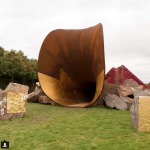
Anish Kapoor had no idea what he was getting into when he accepted the invitation to install artworks in the gardens of Versailles. On September 30, right wing politician Fabien Bouglé, a local councilman, published an article on the website of Nouvel Observateur in which he claims that the artist “has declared war on France” and urges Kapoor to “stop the war on our country.”

The article appeared only three days after the sculpture Dirty Corner wasvandalized for the fourth time—an unknown attacker scratched the word “Blame” into the gold leaf that now covers the previous defacing.