The Whitney Opens with a winner

Let’s cut to the chase: the Whitney Museum of American Art’s inaugural show in its new home in the Meatpacking District, “America Is Hard to See,” is outstanding. With about 600 works by a little over 400 artists, it offers a history of American art—and America—that is richly textured and that teems with beloved classics and electrifying surprises. I am in love with it, and I suspect I will not be the only one.

The opening of Renzo Piano’s building, which gives the Whitney about 63,000 square feet of exhibition space (inside and out), nearly twice what it had in the Breuer Building on the Upper East Side, was always going to be the event of the season in New York, but this exhibition, which borrows its title from a Robert Frost poem, means that we can all truly rejoice. It is a thrilling development for the city, and I am already fantasizing about—and bracing myself for—the wave of soon-to-be artists who will grow up with this space and be inspired by it.

But for now, while the show runs, we get to savor it. Countless minor, subtle decisions have yielded an exhibition that is by turns joyous, sinister, celebratory, and mournful. It is deeply considered, and deeply inspiring. I am looking forward to spending many long days with it.
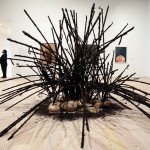
NYT Review: New Whitney Museum’s First Show, ‘America Is Hard to See’

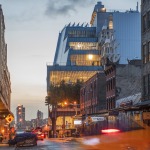
From outside, Renzo Piano’s new Whitney Museum of American Art, set beside the Hudson River, has the bulk of an oil tanker’s hull. Inside is entirely different. The galleries, with high ceilings, tall windows and soft pine-plank floors, are as airy and light-flooded as the 19th-century sailmaker’s lofts known to Herman Melville, who worked as a shipboard customs inspector where the Whitney now stands. Art feels at home in them, and the work in the museum’s top-to-bottom inaugural show is homegrown.

In a real sense, the new building is the least of the Whitney’s concerns. For better or possibly worse — there have already been protests over its proximity to a pipeline carrying fracked fuel — it’s a done deal. If it lets art put its best foot forward and gives it an effective stage for shaping culture, it’s been done well. Besides, most museums tend to turn into “classics” within a generation or two. And always, it’s the institutional thinking, inherently political, that matters — determining first what and who goes into the collection, then what goes into the public spaces and lastly what new, alternative eyes will be coming on board to oversee these things. With the move, the new Whitney makes a promising start. It shakes art and itself up, bracingly, at least a little. Once the opening parties are over, I want it to do much more, to become the living museum of history-in-nowness this city has been waiting for.

11 Art World Rules Decoded for 20-Something Newbies

For a newcomer, the art world can often feel like a social minefield, booby-trapped so that as soon as you start to make progress in establishing a name for yourself, you screw it up with a big-time blunder. Luckily, we’ve got you covered on how to navigate everything from an open bar to a Twitter troll.

Here are those unofficial rules and our helpful tips for decoding what they really mean:

1. Go to the openings “for the art.” …

Does the New Whitney Museum Herald a Golden Age for New York Institutions?

The Whitney Museum of American Art’s Meatpacking District museum, opening May 1, is fiercely awaited. In its new building, designed by Renzo Piano, the galleries and sculpture gardens will nearly double the museum’s previous exhibition space, with two floors devoted to showing off its collection. The museum expects to take in spillover from the millions of yearly visitors who regularly traipse the High Line. Yet, despite having made the kinds of changes that often unleash torrents of criticism (take a look at how the public responded to the MoMA’s and the Frick’s planned expansions—see MoMA Moves Forward with Folk Art Museum Demolition and “Save the Frick” Petition Racking Up Signatures), museum insiders we spoke with are, surprisingly, unanimously bullish on the museum’s move and amplified digs.

“The only way to think is to think big,” former Museum of Modern Art curator Robert Storr told artnet News by phone from his office from Yale University School of Art, where he is the dean. “The Whitney is doing everything necessary to prepare the ground for them to land well.”

The Four-Hour Art Week? Read Carol Bove’s Self-Help Guide for Artists

You do need to know some art history. As a producer of art objects/gestures, the conventions you decide to ignore and the conventions you decide to repeat are as important, if not more so, than what you invent. If you’re a total novice start with Cubism to Surrealism and then study 1945–75, then take it from there.

Everybody my age read Art After Modernism: Rethinking Representation. If you ever want to understand something about our subconscious, our unarticulated assumptions, you could get some clues from that book. The theory of the 1980s is important for the very reason that it formed our mentality, but it has receded from our conscious thoughts. The subconscious realm of unarticulated assumptions is a powerful, invisible shaping force in the world.

When Is Artist-on-Artist Theft Okay?

New York artist Jamian Juliano-Villani is being accused by another artist of having sticky fingers. Brooklyn’s Scott Teplin sees too much similarity between a small painting by Juliano-Villani, now on view at West Village gallery Gavin Brown’s Enterprise, and a painting of his own.

Juliano-Villani explained her thinking in a Facebook comment:

It’s important to realize that all visual culture is fair game for artistic content, ‘appropriation’ isn’t a ‘kind’ of work, it’s almost all art. When making a painting or a print or a sculpture, it’s nearly impossible to make something without thinking of something else. A good reminder that when dealing with images 1) once an image is used, it isn’t dead. it can be recontextualized, redistributed, reimagined. 2) It should have several lives and exist in different scenarios.


Theaster Gates, the artist whose latest project is regenerating Chicago

Gates made his name by staging soul food dinners in honour of a fictional Japanese potter. Now he is recycling the fabric of Chicago’s past, including its bricks and mortar, to transform the city’s depressed areas.

In 2007 Theaster Gates held a series of soul food dinners on Chicago’s South Side to honour his mentor, Yamaguchi, a gifted Japanese potter who fled Hiroshima for Mississippi, where he had heard there was a special kind of clay. There Yamaguchi married a black woman and created a unique ceramic style by blending Asian and African-American techniques. They built a pottery, and brought people together to talk about equality. To Gates, who had spent some time studying in Japan, he bequeathed the task of “fostering social transformation” by “convening dinners in cities with extreme racial and social tension just beneath well-articulated geographical boundaries”. On the wall, in an 85ft strip of vinyl, was a timeline that covered everything from the Ming dynasty to slavery, including Yamaguchi and Gates’s birthdays. At the table was Yamaguchi’s son, representing his father and endorsing Gates’s efforts.

Patrick Painter – The Genuine Article

JOHN NEWSOM: So, how did you discover art? What was your ‘eureka’ moment?

PATRICK PAINTER: Well, when I was 28, I was living in Paris, and I was working for an insurance company, Metropolitan Life. One day I said to myself, “I don’t know anything about art, so I’m gonna start looking at art.” It’s not like I wanted to, it just seemed appropriate. You know what I mean? I mean what else are you going to do in Paris? You can’t go to Disneyland and shit. You know what I mean? You can’t go surfing.

JOHN NEWSOM: True. That’s very true. You can’t go surfing in Paris.

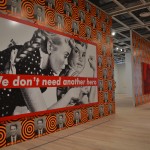
PATRICK PAINTER: So I’m looking around the Pompidou, and I’m seeing Cy Twombly and I’m seeing all these artists, and I’m just hating it dude. I saw many things there that disturbed me, but one in particular was this Gilbert & George. Now… I’m from Long Beach, California… I went to military school… which is kind of like a big gang fight to begin with, and then I got kicked out of military school and really went to gang school. So you know, I had these kind of street instincts, by necessity not by desire. Also, the surfing and the skating in the early 60’s. So when I saw this Gilbert & George, they’re standing there with their fingers in a ‘V’, which I had no idea that in England a ‘V’ meant ‘fuck you’. But at the bottom of the picture it said, “Fuck You” in case you didn’t know what it meant.


The daring art of Marlene Dumas: duct-tape, pot bellies and Bin Laden

Seven years ago, Marlene Dumas briefly became the world’s most expensive living female artist, a dizzying upward move that was reported, somewhat breathlessly, in newspapers from New York to Tokyo (her 1995 paintingThe Visitor was sold by Sotheby’s for £3.1m; previously, her prices had stood at around the £50,000 mark). Yet her name remains, here and elsewhere, relatively unknown. She is, you might say, the world’s most un-famous famous artist, beloved of curators and collectors, but lacking any of the tinny razzmatazz – the self-publicity, the production lines – we’ve grown accustomed to when it comes to 21st-century art. Thanks to this, the huge retrospective of her work at London’s Tate Modern next month – it will include more than 100 of her provocative and intensely dark paintings, drawings and collages – is, at this point, a hot ticket only for those in the know.

Take Your Time – New painting at the Museum of Modern Art.

Don’t attend the show seeking easy joys. Few are on offer in the work of the thirteen Americans, three Germans, and one Colombian—nine women and eight men—and those to be found come freighted with rankling self-consciousness or, here and there, a nonchalance that verges on contempt. The ruling insight that Hoptman proposes and the artists confirm is that anything attempted in painting now can’t help but be a do-over of something from the past, unless it’s so nugatory that nobody before thought to bother with it. In the introduction to the show’s catalogue, Hoptman posits a post-Internet condition, in which “all eras seem to exist at once,” thus freeing artists, yet also leaving them no other choice but to adopt or, at best, reanimate familiar “styles, subjects, motifs, materials, strategies, and ideas.” The show broadcasts the news that substantial newness in painting is obsolete.

– Peter Schjeldahl

Abusing the Marquis de Sade

PARIS — Georges Bataille, in The Accursed Share, said that if the Marquis de Sade had not existed, he would have had to been invented. But probably one of the biggest badasses of all time did exist. And, as if to prove it, on the bicentenary of the death of the “divine marquis” (Donatien Alphonse de Sade) the Musée d’Orsay has put together a sex sellsblockbuster exhibition: Sade: Attacking the Sun.

Given the exhibition’s spew of explicit sexual and violent images, one may thank the French again for their social-sexual candor and maturity, as this is a show I imagine might be impossible to mount (pun intended) in the repressive cultural/political climate of the United States — as well as many other countries in the world. It is a bit subversive, titillating, and instructional in its complex beatitudes, with brilliant pieces of visual metamorphosis by Ingres, Francisco Goya, Eugene Delacroix,Théodore Gericault, Paul Cézanne, Rops, Duchamp, Man Ray, Hans Bellmer, and Rodin, amongst many others.

Jonathan Jones’s top 10 art shows of 2014

From Anselm Kiefer’s rotting sunflowers to a rollicking super-show all over Scotland, via Rembrandt, Matisse, Andy Warhol and Egon Schiele … it was an eye-opening year.

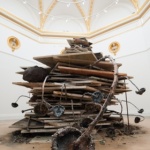
From the rusty submarines hanging in a vitrine in the courtyard to bookworks in which photographs and black paint created eerie provocative assemblages, Anselm Kiefer’s retrospective rocked me. In a year of eye-opening exhibitions of old and modern masters, it was something else to encounter a living giant. Like a novel by Thomas Pynchon or a building by Frank Gehry, the paintings of Kiefer make me feel that our time is truly creative. He is at once remarkably serious and riotously pleasurable.

I find him stupendous. When he started nosing in the muck of history, he was forcing Germans to face their own past. That battle may be won now. Today, he makes us all see that no great art can be made without memory and history. Kiefer stands on the blood-soaked soil of Europe and makes something grow in it. A giant sunflower, rotting yet majestic. It is the soul of our troubled continent.

The Worst: 10 Terrible Art World Moments of 2014

Putting aside any petty concerns for bridges burned, here’s an incomplete list of the most despicable moments in 2014’s art world, as viewed by Scott Indrisek of Blouin Artinfo.com.  From from candy factories to soggy concerts, there are two sides to every story, right?

Year of record sales, but at what cost to the art?

Unease grows as it gets harder for artists to resist servicing a booming market

The art market appeared to be in rude health as 2014 drew to a close. More money was spent on blue-chip and emerging art last year than at any other point in history, and the trade has been in rapid expansion mode. But under the surface, the tectonic plates are shifting, and unease is bubbling up about the effects of the market on the art that fuels it.

“The market has been eating the art,” says Robert Storr, the dean of the Yale University School of Art. “There are still good dealers who understand the danger, and artists who can say no. But we’re in a perilous position and we need to talk about it.”

Such upheaval could be imminent, Levin says. He points to the drastic slump in oil prices and the collapse of the Russian rouble in December, and to the contraction in Chinese manufacturing and currency volatility in the financial markets. “Should the contagion spread to the US economy, then it’s anybody’s guess as to how it will play out,” he says. “It is quite possible that the art market has reached a summit.”

Year in review: six things you need to know about the art market

2014 has been a year of increasing disruption in the art market. While its vastly increased value over the past ten years (€47.4bn in 2013 compared to €18.6bn in 2003, according to the latest Tefaf report by Clare McAndrew) has inevitably brought change, 2014 has seen those changes magnified and evolving in directions that were not previously predictable.

Europe’s 10 Best Art Fairs in 2014

This year hasn’t even come to an end. Yet, intrepid gallerists and collectors are no doubt already pulling out their calendars to mark out the fair circuit for the year 2015. To help weed out the best from the rest, artnet News’ European editors sorted through the stacks of notes and reports from the year’s fairs to see who came out on top in 2014. Time to book your flights.

The Most-Read Articles of 2014 – Artnews

To meet the needs of the season, a list follows below of some of the most popular stories that ran on the ARTnews website in 2014, ranging from artist profiles and investigative stories to on-the-ground art-fair coverage and breaking news. They are divided by month, and presented in no particular order. 

Lots here to read, to get ready for 2015.

The 20 Most Powerless People in the Art World: 2014 Edition

While other art publications sing the praises of the rich and powerful, we like to look at those who are largely overlooked (or worse, exploited) in order to understand the real state of the art world and its discontents. So, here you have our annual assessment of those below the most powerful.

powerless20badgeAnd yes, we’ve finally unhitched the Powerless list from the now predictable power rankings that clamor for our attention in the fall.


Best of 2014: Art

The year hasn’t been short of blockbuster surveys and brilliantly curated displays, as well as smaller, more focused surveys that have been unjustly overlooked but which have proved quietly groundbreaking in their own way. The best exhibitions, which are not, of course, always the ones with the biggest fanfare, nor even the best loans, usually forge a new appreciation and understanding of the artist(s) under the spotlight. They make you radically rethink, knock back lingering prejudices and break down resistance. In other words, they disarm you. The three or four that have lingered longest in my mind, and have kept troubling it, did just that. Others simply showed great and familar artists to best advantage, creating the best possible space for the subject to shine.

Here’s Fisun Guner’s choice of the top eight exhibitions of the year.


Poverty lines: where are the poor in art today?

Caravaggio, Bruegel and Van Gogh all made studies of the poor in spite of rich patronage. Why aren’t more artists doing that now?

Art has a long history of entertaining the rich. From ancient artisans who made gold drinking cups for kings, to the artists of today who sell installations to plutocrats, art has been a luxury product, the servant of money. And yet it also has a social conscience. At this consumerist time of year, it is worth looking at some of the ways artists portray poverty.

So here we are in the 21st century. The forward march of labour ended some time ago. How do today’s artists portray poverty? Interesting question – for perhaps wealth has never been more raw and obvious in the art world.