
Yoko Ono’s Market Is A Mystery Despite Her Superstar Art World Status

After 40 years of neglect from critics and abuse from Beatles fans, Yoko Ono, over the past decade, has risen to an almost untouchable position in the art world. In her 2000 show at New York’s Japan Society, Michael Kimmelman writing for the New York Times called her “a mischievous, wry conceptual artist with a canny sensibility.” In a glowing review of Yoko Ono’s 2014 retrospective at the Guggenheim Bilbao, critic Jonathan Jones called the show “moving and beautiful.” A 2012 story in the Guardian about her retrospective at London’s Serpentine Gallery noted that “deserved recognition” was coming, both in the form of the show, and in the Golden Lion award she received at the Venice Biennale in 2009. The current major Yoko Ono show at MoMA, “One Woman Show, 1960-1971,” is drawing crowds and garnering rave reviews.

Yet for all of her recent popularity, in the realm of auctions, Ono’s status isn’t soaring to the same heights. Her work has never even been featured in a major evening auction and for an artist of her stature, her market here seems practically non-existent.
7 Influential Installation Artworks You Should Know

Bursting out of the frame and off the pedestal, installation art has proven to be one of the most vital artistic innovations of the past century. Its practitioners—including Robert SmithsonMike Kelley, and Yayoi Kusama—appreciate its anything-goes sensibility and relative absence of historical baggage. Individual installations may take the form of architectural interventions, taxonomic collections, or large-scale landscaping projects, but they have in common a search for a new kind of aesthetic experience. The following boundary-breaking examples are excerpted in their entirety from Phaidon’s The Art Book.

Hans Haacke on “Gift Horse,” Gulf Labor, and Artist Resale Royalties

Early last March, London’s Conservative mayor Boris Johnson unveiled Hans Haacke’s “Gift Horse,” the tenth commission installed on Trafalgar Square’s Fourth Plinth. Described on the Greater London Authority’s website as a rumination on the “link[s] between power, money, and history,” “Gift Horse” consists of a bronze horse skeleton and a live electronic ticker of the London Stock Exchange. During the unveiling, both Johnson and Haackeevaded questions about the work’s meaning; Johnson acutely aware of the sculpture’s import during a period of harsh economic austerity, and Haacke preferring to leave the interpretation of his work to viewers.  Read the question and answer:

TM: Have you ever attributed specific political and social changes to your art?

HH: That would be megalomania!

Europe’s Top 55 Galleries You Need To Know—Part 2

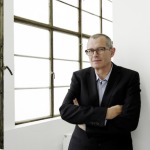
Artnet News Part Two of the top 55 European Galleries is below, including Iceland, Italy, Ireland, Norway, Portugal, Sweden and the UK.   Pictured is Nicholas Logsdail, Founder and Director of London’s Lisson Gallery, representing a wide range of significant conceptual artists including:

Marina Abramović, Ai Weiwei, Allora & Calzadilla, Art & Language, Cory Arcangel, Broomberg & Chanarin, Daniel Buren, Gerard Byrne, James Casebere, Tony Cragg, Angela de la Cruz, Richard Deacon, Nathalie Djurberg & Hans Berg, Spencer Finch, Ceal Floyer, Ryan Gander, Dan Graham, Rodney Graham, Carmen Herrera, Susan Hiller, Shirazeh Houshiary, Christian Jankowski, Peter Joseph, Anish Kapoor, John Latham, Tim Lee, Lee Ufan, Sol LeWitt, Liu Xiaodong, Richard Long, Robert Mangold, Jason Martin, Haroon Mirza, Tatsuo Miyajima, Jonathan Monk, Julian Opie, Tony Oursler, Giulio Paolini, Joyce Pensato, Florian Pumhösl, Rashid Rana, Pedro Reyes, Fred Sandback, Wael Shawky, Santiago Sierra, Sean Snyder, Jorinde Voigt, Lawrence Weiner, Richard Wentworth

Europe’s Top 55 Galleries You Need To Know—Part 1

According to Artnet News, Part One of the top 55 European galleries is below:

Europe’s cities offer a wealth of contemporary art galleries, making the continent an important destination for art lovers across the world.

Those looking to admire both established and leading artists, as well as seek out new and emerging talent, flock to Europe’s top galleries in the obvious choices such as London, Berlin, and Paris—not to mention Basel—but also to lesser-known hot-spots like Istanbul, Budapest, and Athens.

While London may be the dominant center, offering a one-stop-shop option for traveling Middle Eastern, Russian, and Asian collectors, in addition to home-grown ones, the European art markets continue to thrive and excite. What’s more, Europe’s galleries are usually “must-go” destinations if you are following an emerging European talent.

Chinese Authorities Return Passport to Ai Weiwei after 4 Years

On Wednesday morning, Chinese artist and prominent dissident Ai Weiwei announced via an Instagram post that Chinese authorities have returned his passport. “Today I got my passport” his Instagram caption read.

Ai Weiwei and his many supporters around the world are thrilled at the news that his passport has been returned after 600 days,” Ossian Ward from Lisson Gallery, which represents Ai Weiwei, told artnet News in an email. “Having been denied foreign travel since his 81-day detention in 2011, Weiwei now has the possibility to visit his son and his studio in Berlin as well as some of his many forthcoming museum exhibitions around the world, including major shows this autumn in London, Paris, Helsinki and Melbourne. However, he intends to remain based in Beijing, his home,” Ward added.

Wael Shawky’s Epic Films Will Completely Change How You See the Crusades

Egypt-born and -based Wael Shawky inhabits the epic’s structure impeccably, and in the most unexpected way possible: with puppets. In a lush, labyrinthine trilogy of films being exhibited at MoMA PS1, he uses sublimely designed, marvelously costumed ensembles of marionettes and puppets — some made centuries ago, others fashioned by the artist of Murano glass.

Shawky’s films remind us that only one day after September 11, 2001, George W. Bush called for a “crusade.” Almost echoing Pope Urban II, he incited the West to “defend freedom and all that is good and just in the world.” Shawky’s art makes us know this in our bones, makes us wonder if we’re addicted to and in satanic love with war. After thousands of years, the words attributed to Plato only ring truer: “Only the dead have seen the end of war.”

Brancusi to Bourgeois: The Evolution of the Human Figure in 7 Twentieth-Century Sculptures

Though technologies and fashions may develop over the years, the human body is supposed to remain constant, a basic form we can all more or less agree on. In the tumult of the 20th century, however, the human figure became the site of immense change as artists struggled to represent our fragile bodies in a time of unprecedented advancements and horrors. These seven sculptures from the past century, each excerpted from Phaidon’s The Art Book, show just a few of the ways artists reimagined what the human figure could be.

Yvon Lambert Moved to Tears At Inauguration of Collection Lambert Museum in Avignon

It was a visibly emotional event for veteran art dealer Yvon Lambert. On July 10, Lambert celebrated the long-awaited inauguration of the newly-expanded space of the Collection Lambert in Avignon with high-profile guests and politicians in attendance, including French culture minister Fleur Pellerin.

The permanent hanging of Lambert’s contemporary art collection in the newly-acquired Hôtel de Montfaucon also includes impressive works by Cy Twombly, Nan Goldin, Jean-Michel Basquiat, and Julian Schnabel, and works on paper by Bruce Nauman.

Artist Imi Knoebel: ‘If you want to stay alive, you have to do something radical’

He kickstarted German punk, went on a mission to rescue Joseph Beuys and escaped the eastern bloc pursued by guard dogs. In a rare interview, one of Germany’s leading artists relives his extraordinary adventures.

Imi Knoebel is surrounded by so many colours he has lost count. “I have 600, maybe 700,” he says. They hang like the keys of a xylophone in swatches from the walls of his Düsseldorf studio, arranged by tone so he can locate them easily.

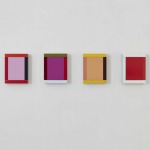
This is a man who once refused to work in anything other than black and white, but who also enjoyed hunting for the perfect green in local paint shops with his artist friend Blinky Palermo. When Blinky died in the Maldives in 1977, aged just 33, Knoebel paid tribute to him with his 24 Colours for Blinky series. Since then, colour has been his driving force.

Now one of Germany’s leading artists, whose first London show opens this week, Knoebel says he will never forget his tortuous early attempts, in his 20s, to make art. “I thought: everything has been done already,” the 74-year-old tells the Guardian in his first ever newspaper interview. “Yves Klein has painted his canvas blue, Lucio Fontana has cut slashes into his. What’s left? If you want to do something, to stay alive, you have to think of something at least as radical.”

Art Basel appoints The Armory Show’s Executive Director Noah Horowitz as Director Americas

BASEL.- Art Basel announced today that Noah Horowitz has been appointed to the new position of Director Americas for Art Basel, starting in August 2015. Based in the United States, Horowitz will direct Art Basel’s Miami Beach show moving forward, further strengthen Art Basel’s relationships with galleries, collectors, artists, museums and institutions from the Americas, and promote them throughout Art Basel’s activities worldwide. Horowitz joins Art Basel’s Executive Committee – led by Marc Spiegler at a global level – alongside Adeline Ooi, Director Asia; Marco Fazzone, Director Resources and Finance; and Patrick Foret, Director Business Initiatives‎.

Art Basel Hires Armory Show Director to Run Its Miami Fair

Art Basel is appointing Noah Horowitz, currently the executive director of theArmory Show in New York, to be its new director of the Americas, running Art Basel Miami Beach.

Mr. Horowitz’s job will be to oversee and lead the development of Art Basel’s outpost in the United States, which takes place each December.

He will report to Marc Spiegler, the overall director of the Art Basel group of contemporary and Modern art fairs. The original Basel version, founded in 1970 in that Swiss city, hosts hundreds of contemporary and Modern art dealers from around the world each June. In 2002, the group added the Miami Beach fair, and in 2013, an iteration in Hong Kong.

Why Are Gagosian, Pace, and Zwirner Signing On for the Seattle Art Fair?

A triumvirate of the world’s biggest galleries—Gagosian, Pace, and David Zwirner—is headed to the Pacific Northwest this month for the debut Seattle Art Fair.

Debut fairs are not always expected to be big sales events, dealers often say, but rather opportunities to start to build relationships with new clients. Goff’s expectations are higher than that. “We definitely do expect to sell work. Will it be as crazy as Art Basel in Miami Beach? Probably not. But we’re binging very good works by a cross section of young and established artists, from Oscar Murillo to Dan Flavin, Donald Judd, andYayoi Kusama. We’re taking Seattle and its collectors very seriously.”

A Fearful Frenzy: The Art Market Now

Life has been happier for many of us in the art world since we stopped caring about runaway commerce in art, which has seemed—but only seemed—to reduce all measures of aesthetic value to raw price. Sure, the billion-plus dollars shaken loose, since May, at three New York and London auctions of modern and contemporary works—with about a hundred and eighty million for a pretty good late Picasso at Christie’s, in New York—stink of compulsion and vanity. So what? We who like to experience and to think and talk about art have plenty to engage us in museums and considerably more than that in galleries, market or no market. I recommend regarding the plutocratic orgy as obscene in ways including the root sense: offstage, out of sight.

But now and then I’m curious about the state of play.

JJ Charlesworth On Why the Art Market Is a Bubble That’s Not Going to Burst

After a reportedly lively and lucrative Art Basel last month, London’s auction sales showed that the secondary market for twentieth century art is firing on most, but not all, cylinders: while Sotheby’s Impressionist and Modern art sale netted £178.6 million or $282 million—the second highest total for any auction held in London—Christie’s less inspiring sale still managed to pull in £71.5 million, or $112.9 million.

The art market’s apparently unstoppable upward spiral has become an almost normal phenomenon, and many commentators have all but given up speculating on whether or when it might come crashing down. It’s easy to get tangled in the impenetrable intrigue of the secondary market—with its buy-ins, third party guarantees, buyers premiums, and the rest of the bizarre lore and shadiness of the business—while the old notion of the art market “bubble” seems no longer to offer a reliable dose of periodicschadenfreude for those who like to see the very rich lose their shirts.

But in reality there’s little reason to believe that the art market will see the same crashes it has experienced over the last thirty years, and last week’s London auctions hold some of the clues to why.

The Many Contradictions of Mona Hatoum

Ms. Hatoum has a solo show of 110 works at the Pompidou, her biggest and most prominent exhibition yet. (It runs through Sept. 28 and travels to the Tate Modern in London in May 2016. A smaller, unrelated show opens at the Institute of Contemporary Art in Boston on Aug. 26.) The nonchronological display includes quietly disturbing installations featuring cages and grids, barbed wire, domestic objects, maps and strands of her hair. Her work is inspired by Minimalism, Surrealism and conceptual art. It occasionally also evokes her Palestinian roots, leading some to see Middle Eastern connections in everything she does, to her lingering displeasure.

One early work — on display here — is “Light Sentence” (1992), an enclosure of wire mesh lockers with a dangling light bulb that casts dizzying shadows. The piece is broadly meant to symbolize confinement and disorientation. Yet the artist (who has never lived in Israel or the Palestinian territories) said one viewer took it to represent a Palestinian refugee camp. “They come with this preconceived idea of where I come from,” Ms. Hatoum said, “and therefore what I’m putting in my work, and they tend to over-interpret the work in relation to my background.”

At Art Basel, a Powerful Jury Controls the Market

The hundreds of gallery owners who apply each year to secure a coveted booth at Art Basel, the Swiss art fair, spend weeks on their admission applications. They describe the evolution of their galleries, track the history of their exhibitions and list the biographies of their artists. Then there is the matter of the “mock booths,” intricate sketches, miniature models, even virtual tours, of their planned exhibition spaces, complete with tiny reproductions of the exact works they hope to exhibit.

As the art market explodes in value and collecting becomes a global treasure hunt, the importance of showing at art fairs has soared, too. Fairs now account for about 40 percent of gallery sales by value, and as collectors flock to destination bazaars in places like Paris, London, New York, Miami and Maastricht in the Netherlands, dealers, museum curators and art-world groupies follow.

“Someone is trying to kiss you somewhere — metaphorically speaking,” a former juror, Claes Nordenhake, said of the lobbying. “And you know that the reason is not because they love or respect you but because they want to come close to the fair.”

Philippe Parreno’s Hypnotism at the Park Avenue Armory

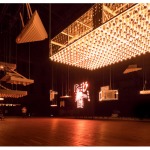
“The architecture becomes semi-conscious,” said Philippe Parreno during a morning press conference debuting his new installation for the Park Avenue Armory, which opens today and is on view through August 2. I believe he followed up this building-coming-alive statement with a comparison to the work of Philip K. Dick — the artist’s thick French accent was a bit hard to parse — an appropriate sentiment for a thrilling exhibition that shimmers between genres, from sci-fi to fantasy, children’s adventure to horror. “H {N)Y P N(Y} OSIS” is near perfect — certainly good enough to excuse its typographically obnoxious title, and maybe good enough to warrant the consideration of curator Tom Eccles’s breathless assertions that Parreno is “one of the most important, if not the most important, artist of his generation,” and the contemporary-art corollary to Marcel Proust.

Parreno doesn’t hypnotize the viewer so much as co-opt him, casting a sensory spell that is lushly atmospheric and intentionally disorienting. Unlike his peer (and former collaborator) Douglas Gordon’s outing in this same venue — from which “H {N)Y P N(Y} OSIS” essentially samples, selectively, with the Steinway performances — Parreno’s exhibition rewards patience. There’s a benefit to letting go, becoming an empty shell to be filled by light, sound, sensation.

HERE AND NOW: PHILIPPE PARRENO’S ‘H{N)YPN(Y}OSIS’ TAKES OVER THE PARK AVENUE ARMORY

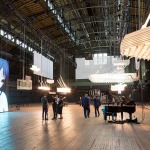
Philippe Parreno’s H {N)Y P N(Y} OSIS (pronounced “hypnosis,” just to confuse us all) is bewildering. Staged in the Park Avenue Armory’s massive drill hall, it’s an installation that involves film, sculpture, music, and performance. It takes at least two hours to get through, and feels as slow and frustrating as the traffic on Broadway during rush hour. But weirdly enough, for patient viewers, H {N)Y P N(Y} OSIS ends up being a rewarding experience.

With H {N)Y P N(Y} OSIS, Parreno overwhelms visitors with information. Could anyone really understand everything Parreno shows over the course of these two hours? It’s better to just let it all sink in—to be reminded, time and again, that visitors are here with many other people, in a large drill hall, in the Park Avenue Armory, in New York City.