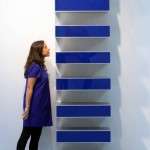
Our nine-year-old was just being ‘anti-establishment’, say parents of girl who climbed on $10m Tate Modern sculpture

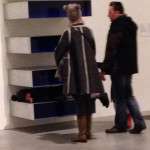
The fashion-designer parents of a young girl who shocked art-lovers by climbing on a multi-million pound sculpture at Tate Modern today said their nine-year-old daughter was simply being “anti-establishment.”  “It’s not right, but they were just interested. Their only crime was to be seduced by a ladder of jewel-coloured shelving. Sissi has always been anti-establishment but she would never hurt anybody.”


What NOT to Do with Kids in a Museum

Bushwick gallerist Stephanie Theodore is at the Tate Modern today and spotted this hilarious/sad/incredible/unbelievable (so many mixed emotions) scene of parents allowing their child to use a Donald Judd sculpture as a … er … a bunk bed.  In response to my question of whether she actually took this almost-hard-to-believe scene she responded: yes.  I told the woman the the kids were using a $10mm art work as a toy, she told me I knew nothing about kids. Obviously, she doesn’t either.

A Squiggly, Neon-Lit Guide to Post-Minimalism

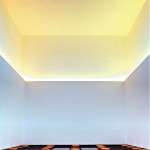
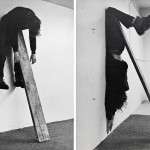
More so than Post-Impressionism or Post-Modernism, the genre of art known as Post-Minimalism is a particularly squirrely one to wrap one’s mind around—after all, what is there beyond Minimalism’s elegant reduction of art to pure form? The critic Roberta Smith may have put it best a few years ago when she described it as “that unruly early ’70s mix of Conceptual,Process, Performance, installation, and language-based art.” But what links all these divergent approaches together?

Classic Meets Contemporary in the Hill Collection – Video

Tomilson Hill and his wife, Janine, have been outfitting? their Upper East Side home with the best of the best that has come to market for decades. The Wall Street financier has an extensive network of dealers and auction-house specialists on the lookout for pieces that might appeal to the couple. The Hill’s collecting strategy: choreographing works from different periods and mediums, from Renaissance bronzes to post-war American and European art. Thirty-two of those bronzes are featured, alongside contemporary works by the likes of Cy Twombly and Ed Ruscha, in an exhibition opened this week at the Frick Collection.

Art+Auction’s Judd Tully sat down with the power collectors inside Hill’s art-and book-filled study study ahead of the Frick exhibition.

Watch the Video.

Paying Respects: Architects Mourn Loss of Folk Art Building

The Society for Ethical Culture was an apt setting for Tuesday night’s conversation on the Museum of Modern Art’s forthcoming expansion. The plan to add 40,000 square feet of gallery space to the museum’s Midtown campus has charged a virulent debate about ethics in the architecture community. Ever since the museum and its architects, Diller Scofidio + Renfro, confirmed on January 8 that the expansion comes at the cost of the adjoining Tod Williams Billie Tsien-designed American Folk Art Museum building, which MoMA purchased in 2011 and will demolish before June, architects and critics have called foul on the institution and its builders for failing to respect and preserve the distinguished work of contemporaries.

Martin Creed: What’s the point of it? Hayward Gallery

Silly, serious and a sensory delight. Work from the artist who won the Turner Prize turning the lights off and on.

If you’re suffering from the January blues, hurry to the Southbank Centre where Martin Creed’s exhibition is bound to make you smile. The man best known for winning the Turner Prize in 2001 by switching the lights on and off at Tate Britain has filled both floors of the Hayward Gallery with things that not only lift the spirits but reveal how to make magic from virtually nothing.

Nor is this an example of art lite; we tend to think of humour as an easy option, but sustaining a joke over five galleries and three terraces is a serious challenge. One false move and the whole thing falls apart; but Creed’s sense of time and space are impeccable. The installation is perfectly poised to keep you engaged, surprised, amused and possibly outraged at every turn.

Art that is beautiful, sensuous, silly and also deeply serious. What more could you want? I stayed for hours and laughed all the way round.

Sobey Art Award Expands Purse to $100K

The Sobey Art Award announced January 27 that it is expanding its purse by nearly 50 percent, solidifying the award’s position as Canada’s leading prize for contemporary artists. Formerly set at $70,000, the Sobey Foundation has increased its total sum to $100,000. The added capital will singularly affect the runners-up, which includes four short-listed artists (who formerly received $5,000 each, and will now be awarded $10,000), and twenty long-listed artists (who were previously rewarded in name alone, but now receive $500 a piece). The award’s top winner will continue to receive a $50,000 check.

Almost Human: Richard Serra

For those unaware of Serra’s oeuvre, he’s made a name for himself by creating building-sized metal sculptures that often make you feel a little unbalanced when you’re next to them. He makes Art with a capital A, and most of us art folk are taught in our earliest art-school days that his sculptures evoke awe. When we photograph them, we’re not just trying to capture the sculptures but also pay the proper reverence we’re told such art is owed. Sometimes that reverence is paid in critical study, but it’s just as often paid in Instagram shares.

Selling art online and reaching new markets: 5 tips for artists

The internet offers the visual art market great potential for growth and change. Currently, online sales make up just 1.6% of total global sales, but this is set to change. In the past couple of years millions of dollars have been invested in online sales platforms. In 2013 Artspace received $8.5m (£5.2m) of investment, Paddle8 received $6m (£3.6m) of investment – backers included Damien Hirst and Jay Jopling – and Amazon Art was launched.

Rachel Whiteread – Exhibition opens at Gagosian, Geneva

Whiteread’s approach to sculpture is predicated on the translation of negative space into solid form. Casting from everyday objects, or from spaces around or within furniture and architecture, she uses materials such as rubber, dental plaster and resin to record every nuance.

The reason my work has affected people over the years is because it draws people’s attention to their lives and the things in their lives. There’s a certain amount of humility that goes with that. —Rachel Whiteread

They Clicked With Investors—Now What? Who Will Win the Race to Sell Art Online?

For two years running, the website Artsy threw one of the glitziest parties at Art Basel Miami Beach, the 2012 edition a Chanel-sponsored blowout at Soho Beach House that went until 3 a.m. Just look at Patrick McMullan! Lenny Kravitz! The Brant Brothers! Dasha Zhukova! Wendi Murdoch! Demi Moore! Vito Schnabel! Pharrell Williams!

In December, 2013, their comparatively modest dinner was scheduled for the same time as Aby Rosen’s party, and not one of those names was in attendance.

One can only read so much into these things, but it wouldn’t be wrong to say that Artsy’s honeymoon may be nearing its conclusion, and with a new competitor in Amazon, the business of selling art online has changed. A few years into their establishment, Artsy, Artspace and Paddle8, the three start-ups that sought to revolutionize the art market (and seem best positioned to do so in terms of publicity and funding) have now entered the period in which they must solidify their business plans.

Martin Creed at the Hayward: the faeces, the phallus …

The Hayward’s Martin Creed show is more like a glorious tour of his mind. Adrian Searle has the time of his life squeezing through balloons, ducking a steel beam – and watching an endless erection.

The variety of Creed’s work makes it hard to talk about touch, manner or voice. But they’re there all the same. His art is marked by lightness and a kind of bravery. It is all a matter of timing, placement and contrast. The show doesn’t flag. Creed’s art is filled with systems, rules and ways of paring things down to some kind of irreducible physical fact or activity: counting, aligning, ordering, arranging.

Creed’s new show at the Hayward in London is great – one of the best solo exhibitions I’ve seen in the gallery.

Watch the video.

Grayson Perry Collects His CBE From Prince Charles At Buckingham Palace

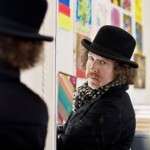
Grayson Perry, the Turner Prize winning artist has collected his CBE from Prince Charles in a ceremony at Buckingham Palace. Dressing as his alter-ego character Claire, Grayson wore a ‘Mother of the Bride’ midnight blue dress and jacket, heels, and an over-the-top Camilla style black hat complete with ostrich feathers. The Queen’s official spokesman commented; ‘His attire was entirely appropriate.’

How Artist Jon Kessler Invented the Web

For the past decade Jon Kessler, the artist and professor in Columbia University‘s Visual Arts program, has been using his character the Global Village Idiot as a way to explore themes of surveillance, interconnectivity, and the slippage between reality and fiction that is created by the forces of digital technology and the Internet. A visionary who appears to be something of a cross betweenHoward Hughes, a Silicon Valley genius in the Steve Jobs vein, and the Unabomber, the Global Village Idiot has staged mind-bending provocations at Deitch Projects (installing state-of-the-art surveillance technology in the gallery), the Swiss InstitutePS1 Contemporary Art Center, and MySpace.

Van Gogh’s Sunflowers, review: ‘a terrific treat on a winter’s morning’

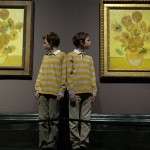
Like seeing double: the Amsterdam and the National Gallery Sunflowers hang side by side for the first time in 65 years at London’s National Gallery.

What would be the ultimate blockbuster exhibition? High up anyone’s list would surely be a show of the still lifes of sunflowers that Vincent Van Gogh painted in Provence between 1888 and 1889.

In a remarkable collaboration, the Van Gogh Museum in Amsterdam is loaning its magnificent Sunflowers to the National Gallery, where it can be seen side by side with its almost identical predecessor, which happens to be the most popular painting in the collection at Trafalgar Square, according to annual postcard sales. It is the first time the two paintings have been seen together in London in more than 65 years. The result is the exhibition equivalent of a game of spot-the-difference.

Martin Creed: Lights, love and loss – the artist whose gift grabs the audience

When Creed opens a retrospective at London’s Hayward Gallery on Wednesday it will be the latest chapter in one of contemporary art’s most glittering careers. It’s hard to believe he was once such a nobody that when this unknown artist sent Work No 88, A sheet of A4 paper crumpled into a ball, to Nicholas Serota, director of the Tate, Serota’s secretary sent it back flattened out – at least that’s what Creed used to say.

He certainly got asked this when he won the Turner prize. Sunday Times art critic Waldemar Januszcak has called Creed “the worst winner of all time of the Turner Prize”. The lights go on; the lights go off. What’s the point of it?

The secret of Creed’s art is that it speaks of ordinary things like love and loss. When someone dies the lights go off. That’s what it’s like. Or like seeing an island slowly vanish in the distance. What’s the point of it? What’s the point of lit?

A Beijing Temple Restored

YOU NEVER KNOW what you’ll find when you go bicycling in Beijing. Eight years ago, the Belgian entrepreneur Juan van Wassenhove set off from his home in the Chinese capital to pedal around the vanishing hutongs, the labyrinthine alleyways that were once the heart of the ancient city, when he glimpsed what appeared to be the tip of a stupa rising above slate-gray roofs. After shouldering open an iron gate, he was amazed to discover a derelict wooden temple with a beautiful double-level main hall crafted by artisans in the Qing Dynasty—a rare architectural treasure. “That day I found my mission,” he recalls.

The Existential Hilarity (or Hilarious Existentialism?) of Jonathan Monk

The artist Jonathan Monk makes work that casts an arch eye on art history, his fellow artists, and the transition of a work from the studio to the gallery to the collector’s wall or museum. In other words, his target is art and the entire artistic process, which he lampoons with wry humor and an unabashed use of appropriation—nothing is sacred, least at all himself.

The Next Big Picture – With Cameras Optional, New Directions in Photography

With Cameras Optional, New Directions in Photography

At first glance, viewers of “What Is a Photograph?” opening on Jan. 31 at the International Center of Photography, will not even recognize the work on the wall as photographic. There is no easily identifiable subject, no clear representational form.  “The show does not answer the question,” said Carol Squiers, the show’s curator. “It poses the question. It is an open question, and that’s why I find this period in photography so exciting.”

Where are the Girls? Jemima Kirke on women in art – video

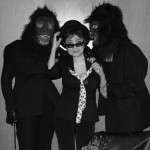
Jemima Kirke of TV show Girls discusses how women have always made art, even if they’ve been absent from the history books (and gallery walls). This short film made by the Tate investigates the role of women as makers, not just muses – from Lee Miller to the Guerrilla Girls.