It is what it was, and what it has become. Where would we be without it?
Say no more …
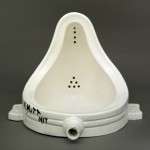

It is what it was, and what it has become. Where would we be without it?
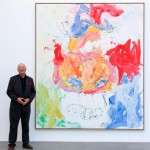
The Britannia Street Gagosian gallery is currently showing the works of Georg Baselitz in Farewell Bill. The new Baselitz paintings are self-portraits that pay reverence to the great artist Willem de Kooning. Baselitz encountered Kooning’s gestural paintings, Woman I and Woman II, as a student in Germany in 1958.
A traditional portrait depicts a realistic image of a person, through exact proportion and anatomical details, while gestural painting is done through an artist spontaneously putting paint on a canvas without any grand plan. An action painting is often interpreted as a reflection of the artist’s unconscious. Baselitz explores these conventionally separate art forms together and intentionally deprived himself of any overview of his canvas during his artistic process, making his self-portraits a reflection of both his outward appearance and psyche.
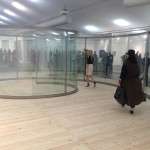
The American Conceptualist Dan Graham has long worn many art world hats. He has produced films and videos, drawings and prints; chronicled rock culture; and collaborated with bands like Sonic Youth and Japanther. But Mr. Graham is perhaps best known for his architectural environments and glass pavilions, which he has been designing since the 1980s. Often constructed of two-way mirrored glass and steel, they are created in such a way that the viewer and the surrounding landscape can become actors in his creations.
Mr. Graham has described his pavilions “as somewhere between architecture and television,” and they have been popular destinations everywhere from the Arctic Circle in Norway to, in 1991, the roof of the Dia Art Foundation in Chelsea, site of his last major commission in New York.
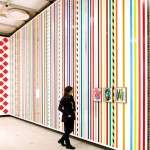
When Martin Creed was shortlisted for the Turner Prize in 2001, it showed him something about himself that he’d rather not have seen. “What I hated was finding out how much I wanted to win,” he says. “Prizes are stupid but God, I was a desperate man!” It’s an uncharacteristic admission in some ways—Creed casts himself as an idiot savant rather than an ambitious hustler—but it is typically disarming. He is a master of the confessional interview.
It was a relatively strong field that year and the favourite was Mike Nelson, creator of eerie architectural installations assembled from everyday jetsam including magazines and furniture. Creed’s piece, Work No. 227: The lights going on and off, consisted of an empty room whose lights flick on and off at five-second intervals. Minimalist enough to mean everything and nothing, it was met with an outraged reaction from all the usual quarters. The Sun outdid itself, launching its own award, the Turnip Prize, and a painter named Jacqueline Crofton was banned from the Tate galleries for life after chucking eggs at the exhibit’s white walls.
Flash forward 13 years, and Work No. 227 is part of the Tate’s permanent collection, acquired for an estimated £110,000, while Creed himself is on his way to becoming a national treasure. Last year, he took part in the Cultural Olympiad, and January saw the opening of his first major retrospective, “What’s the point of it?”, at the Hayward Gallery. The exhibition contains more than 160 works, from sculpture and painting to video and neon. Not content to stick within the confines of the gallery’s five rooms, Creed has spilled out onto the terraces and into the Southbank Centre’s performance spaces with a ballet, a gig played with his band, and the premiere of a composition for the Royal Festival Hall’s newly restored organ. There’s an album, too. And of course, there is full-frontal male nudity, vomiting and defecation.

From Tutankhamun to the ancient Greeks, the church to the Medicis, there’s a long history of shopping for art. Comedian Sally Phillips explains the bulk-buys and the beheadings – then explores the international art fair circuit to find out what’s worth its weight in gold … and why Tate bought the rights to form an orderly queue at any time

Television presenter and writer Dawn O’Porter takes us on a whistle-stop tour of nudity in art, from its origins 25,000 years ago to the present day
With an unflinching gaze, O’Porter tackles the ever-changing rules of acceptability for representing and beholding flesh in art.
Watch the Video!
What’s the connection between a looped high-def video of a carving knife, a row of tall, narrow convex black mirrors, and a hundred-foot-long scroll swarming with shimmering iridescent colors? They are all photographs according to no less an authority than the International Center of Photography (ICP), where they are featured in the exhibition “What Is a Photograph?” on view through May 4.
ICP curator Carol Squiers‘s engagement with the bedeviling question focuses primarily on the 30 years since my photo class, the period in which digital technology has eliminated both film and the darkroom from the practice of many photographers. As Alison Rossiter, one of the artists included here, said recently when talking about the string of technological innovations that make up photography’s history, “we get to witness the biggest one, where—whhhpp!—the whole light-sensitive thing was thrown out.”
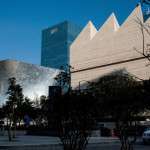
MEXICO CITY — Few devotees, domestic or foreign, seem to find their way to Mexico City’s museums of contemporary art, of which there are several. Nor are any of those museums firmly fixed on the route followed by the packs of art professionals — curators, collectors, dealers — who ritually travel the planet from one art fair or biennial to the next.
But with the recent opening of a new museum here, the Museo Jumex (pronounced WHO-mex), at least one institution may find a place on that circuit. That, at least, seems to be the hope of Eugenio López Alonso, heir to the Grupo Jumex fruit-juice empire, who conceived the Jumex as a private museum with internationalist ambitions but a style of its own.
I have been an invited interloper in the fiefdoms of the decimal-pointed rich long enough now to know that when rich men want to distinguish themselves from other rich men they buy art. Among practitioners of modern-day social one-upmanship this is hardly new. The nouveaux riches of the Gilded Age were the first Americans to discover the class-enhancing power of nailing a Titian above the mantel. But those robber barons were different from ours in a very important way: To those less formally educated, more red-bloodedly capitalist men, art was a way to wash themselves clean, to refine their own taste and that of their fellow citizens, and in that way to share some of the vast wealth that had been made by the few in disproportion to the many.
A woman walks into a grocery store and asks the clerk for some broccoli. The clerk responds that they’re fresh out of broccoli, but the woman refuses to yield on her request. After a bit of back-and-forth, the exasperated clerk offers:
Clerk: Ma’am, spell the “car” in carrot. Woman: C-A-R.
C: Okay, now spell the “let” in lettuce. W: L-E-T.
C: Very good, now spell the “fuck” in broccoli. W: [pause] There is no fuck in broccoli.
C: That’s what I’ve been trying to tell you!
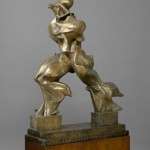
Famously inspired by a car crash, Futurism burst forth in 1909 with an uncompromising agenda. Its poetics, as decreed by Filippo Tommaso Marinetti in his manifesto, would be “courage, audacity and revolt” nurtured by “fire, hatred, and speed.” Museums had become “cemeteries,” Marinetti wrote, and should be demolished, along with libraries, to deliver Italy from the burden of its history. Along the way, Futurism delivered one of the most important multidisciplinary strands of avant-garde modern art, best remembered today for energetic and fractured paintings that grapple with new ways of seeing.
Million dollar Ai Weiwei vase smashed. Mr Ai Weiwei said he did not support artists destroying other artists’ work. An American artist has been arrested after smashing a million dollar vase painte.
A vandal was arrested after breaking a million-dollar vase at the Perez Art Museum Miami (PAMM). According to the Miami Police report, a museum security guard.
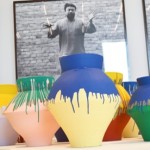
A Miami painter who destroyed a priceless Han dynasty vase in a “spontaneous protest” at the city’s new art museum claims he thought he was smashing a cheap garden pot.
Maximo Caminero said he picked up the ancient urn from an exhibition curated by the Chinese dissident artist Ai Weiwei at the Pérez Art Museum Miami (PAMM) on Sunday and threw it to the ground because “the museum only displayed international artists” and ignored the work of locals.
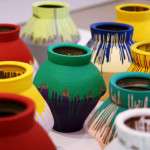
MIAMI — Officials at the recently inaugurated Pérez Art Museum Miami confirmed on Monday that a valuable vase by the Chinese dissident artist Ai Weiwei had been deliberately destroyed by a visitor in what appeared to be an act of protest.
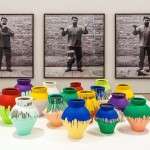
An attack on the Chinese artist’s installation in Miami has been condemned as an act of vandalism. Why is smashing art only acceptable if an acclaimed global artist does it?
A “protest” at a Miami art museum raises some questions about what exactly art is, now.
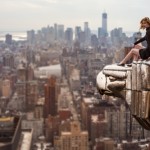
British adventure photographer Lucinda Grange has travelled the world, scaling famous buildings and structures and taking pictures from the top. Among her impressive list of climbs is the Great Pyramid of Giza, Firth of Forth Rail Bridge in Scotland and the Manhattan and Brooklyn bridges.

The underside of the Granville Street Bridge in Vancouver will be turned into a surface for artworks in lightboxes as part of the Vancouver House project.
The forgotten urban area under the bridge is being reclaimed as part of the development. Westbank Projects is planning to bracket the main section of the bridge with low-rise buildings and create a new, covered urban plaza downtown. On special occasions, the area could be used for beer gardens, public art openings, concerts and other public events.
Is this an understated version of New York’s wonderful High Line? Perhaps …
London—The contemporary art market continued its steady climb at Sotheby’s on Wednesday night, with a sale dominated by a strong grouping of paintings by international blue chip artists that brought in £87,915,500 ($144,550,665).
Ten of the 57 lots offered went unsold, for a trim buy-in rate by lot of 17.5 percent and seven percent by value. Twenty of the forty-seven lots that sold fetched over a million pounds and twenty-three made over a million dollars. The results were comfortably in the middle of the pre-sale expectations of £68,450,000-93,110,000 ($112,545,490-153,091,462), and the tally surpassed last February’s total of £74,364,200 ($116,357,664) for the 44 lots sold.
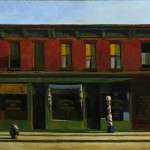
Did American painting exist before Abstract Expressionism? Not such a daft question if we don’t get to see any of it.
Many will still argue that American painting before mid-century, with just a few exceptions, is really too derivative, too backward-looking to get excited about, and that it was photography that American artists really excelled at in the first half of this century. Furthermore, it was the intellectual exodus from Europe to New York before the outbreak of the Second World War that really gave American art its injection of life-blood.
American photographers certainly excelled. But here’s a selection of paintings by artists who also excelled in the first few decades of the 20th century – though not all follow the precept of being rooted in American experience etc.